US roadtrip in an American workhorse
Design driven: Jeep Wrangler

Michael Nash takes the Jeep Wrangler on a three-week road trip across north eastern America, travelling through nine states and across two time zones
Tucked away in an unassuming carpark, just a stone’s throw from New York’s famous High Line walkway, is a 2025 Jeep Wrangler. The last time I had driven a Wrangler was back in 2020, traversing the wild snow drifts of Montréal in a sub-zero frozen February, so I was keen to see how the latest model fares in similarly extreme conditions.
First impressions
At a glance, the 2025 Wrangler appears very familiar. It has retained all of its charming exterior design features that have been present for generations, like the round headlamps and enormous wheel arches, and its stance on the road is as bold and boisterous as ever. It is chunky and boxy – a shape that many have come to love. What I did not expect is the bright orange ‘Joose’ paintjob. Love or hate, it certainly makes for an easier spot in a busy carpark.
Leaving the chaos of New York, we take the I-95 south, switching the magical city skyline for an equally beautiful industrial metropolis, very Lynchian. It quickly becomes apparent that the ride is remarkably smooth. Jeep’s “body-on-frame” design with front and rear five-link coil suspension system means that the cabin floats across the ground. The third generation axles, supplied by Dana, complete the buttery glide. There are some otherworldly potholes on the I-95, as the traffic on this major artery in and out of New York is never anything but ridiculous, yet the Wrangler breezes over them.


The interior design team has done a tremendous job of balancing functionality and ruggedness with creature comforts. We are testing the Sahara trim, which is one of two four-door variants, and feels plenty spacious inside, complete with a decent boot that can fit four suitcases.
There is room to spare above my head (I am a square six feet tall), and no shortage of leg room either. The pillowy Nappa leather seats provide ample support while remaining soft and cushiony. Most of the surfaces within reaching distance are leather and chrome, while the lower third of the cabin consists of hardwearing plastics that can be easily hosed down.
As we drive on, the factories in New Jersey slowly give way to the vast flat farm lands of Pennsylvania. The wind picks up, and the soft cloth top of the Wrangler clings on for dear life. Noise in the cabin becomes deafening at 70mph, but a high quality ‘Alpine’ sound system cranked up masks the worst of it and allows us to keep relatively sane.
Back in time
Our first stop is the town of Lancaster, home to a large Amish community that still gets around using horse and cart. The obvious etiquette is to slow down and give a wide berth when overtaking, and although I follow this, I can’t help but feel the eyes of a few disapproving onlookers that are far from enamoured by my driving ability and the Wrangler’s garish paintjob.


After an interesting thanksgiving meal inside an old train carriage, we drive through Ohio before entering Michigan, where the snow starts to deepen. Muskegon is a small, sleepy lakeside town on the south eastern side of lake Michigan. It is quiet in the winter, the only holidaymakers being cross-country skiers and, apparently, musicians. It is here, amid the 20-inch snow drifts and giant patches of black ice, that the Wrangler starts to show its prowess.
The 18-inch wheels with all-season tyres maintain their grip, sliding only when the accelerator is firmly pressed. Rogue piles of snow are no problem either as the Wrangler boasts ten inches of ground clearance. This can make it a little tricky to jump in and out of the car for those that are less nimble, but on the flip side, the high riding position makes for a good view of the road ahead.
The windscreen wipers could perhaps be a little more heavy-duty as ice repeatedly gets stuck to the glass and, even on the max setting, the thin blades seem to have no chance. In fact, the blizzard is so strong at one point that the wipers do little to clear the windscreen, so I am forced to crawl along at 10mph as we approach The Red Rooster Tavern for a bite to eat.


Free lunch
Skirting the edge of Lake Michigan, we head to Chicago to spend a few days wandering the city, rushing into various museums to warm up. It is tricky and expensive to land a parking space, and the Wrangler isn’t the smallest car to squeeze into a city spot, so we soon decide to move on.
Just south of Chicago lies a small industrial town called Gary. A brief pit stop at the Great Lakes Cafe turns into a frantic search for the key. Is it back in Chicago, dropped in the snow or down a drain? But surely the car would not continue to operate without screaming bloody murder? Panic over – the keys are found buried underneath luggage in the boot after having dropped out of my jacket pocket. And a bonus – our meal at the cafe is covered by some locals who take a shine to our exotic accents.
The I-65 south takes us directly through the heart of Indianapolis, just in time for rush hour. It’s during this six-hour driving stint, and the many miles of traffic jams, when I begin to notice the excitable nature of the adaptive cruise control (ACC) system. When the system slows down for a car ahead and I change lanes to overtake, the gears will hop down drastically to deliver more torque to the 3.6-litre V6 engine, which now screams under the bonnet. It is as if the set speed must be immediately regained, and the system is unable to slowly and smoothly accelerate. This is not a problem, but when it happens repeatedly over the course of many hours, even when the difference is only from 65 to 70mph, it can become fairly irritating.

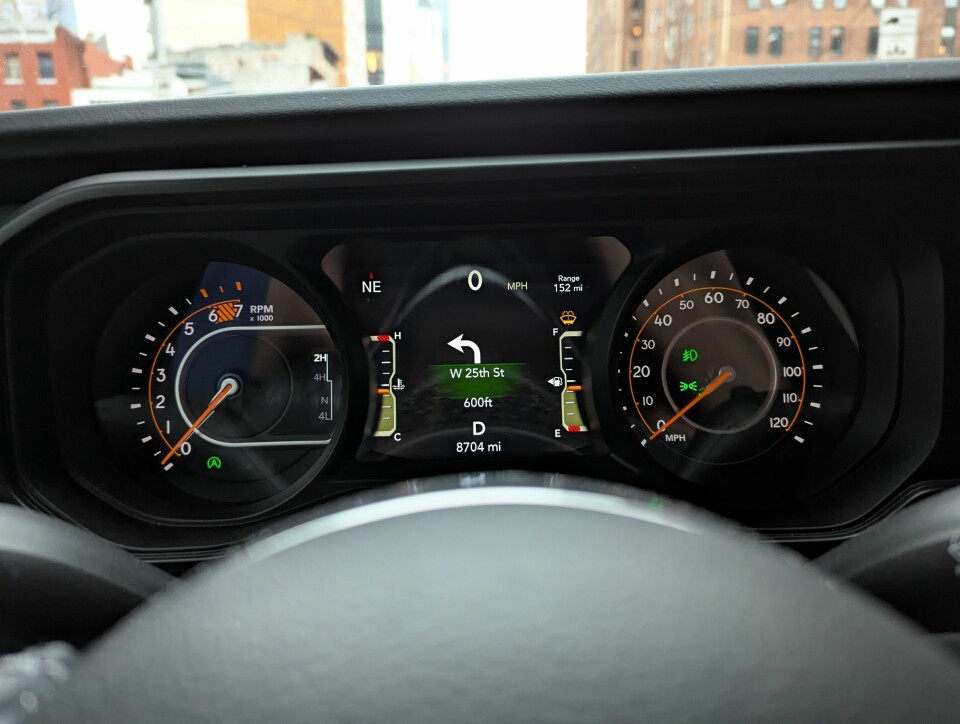


ACC aside, the gearbox is effortless and the engine otherwise gently purrs along without so much as a grunt. However, it does need refuelling very regularly, with a combined highway and city 20mpg, averaging five gallons per 100 miles. The Wrangler, therefore, is expensive to run, but thankfully petrol prices in America still remain low when compared to the UK.
Not for the faint of heart
After another short stop in Louisville, we head for the mountains once more. The landscape starts to get more interesting between Kentucky and West Virginia. We pass over a number of wide rivers, through valleys, and across the top of the Daniel Boone National Forest. Another dump of snow greets us when we wake up next to the New River Gorge Bridge in Fayetteville.
To get to the bridge from our accommodation we must climb a small but steep hill, so for the first time on the trip I buckle up and select the 4L setting (four-wheel drive low range), which uses lower gears for maximum torque and traction. A slow, rolling approach, and easing on the accelerator, we crest the top of the hill with no problems, and I throw the car back into 4H (four-wheel drive high range). But others have not been so lucky. We pass a pick-up that had, just minutes before, slid on a patch of black ice and ended up buried in a ditch. Luckily another 4x4 is on hand to help out, although it would have been interesting to see how the Wrangler would have coped with the weight of a much larger vehicle in tow.


Back to start
Leaving West Virginia behind, we make a brief stop in Philadelphia for a necessary cheesesteak dinner before circling back to New York. The Wrangler has been our companion for nearly three weeks, and I am sad to hand the keys back. It handled the ice and snow drifts with aplomb, keeping us safe and warm(ish) for our American roadtrip.