Industrial design cues inform new approach to commercial vehicle interiors

Commercial vehicles are rarely associated with playful CMF and interior design, but one Detroit company aims to change that

The commercial vehicle (CV) sphere is immensely broad, and while it shares much of its design disciplines with passenger cars, the priorities are quite different. CVs are workhorses – tools for a job – and ideally the cheaper the better. It all typically leads to standardised, plain and uninspiring products.
Indeed, traditional considerations around beauty and materials sit far lower in the pecking order with CVs, but one Detroit-based company is on a mission to change that. Grounded RV is placing a keen emphasis on CMF and modularity, creating spaces that are bespoke for the job and fundamentally pleasant places to spend hours on end.

The company has been running for around three and a half years and, after starting with modified electric camper vans, business soon blossomed and vehicles were tweaked for a B2B customer in healthcare. Numerous other industries apparently saw similar use for Grounded’s RVs – from roaming coffee shops to mobile dentists — and the company now supports a whole raft of different sectors.
At the heart of this is the “modular platform” says chief product officer Nadia Meyer, who leads design activities alongside co-founder Nick Fitzpatrick. Both describe themselves as ‘multi-disciplinary’ and both have a remit that extends far beyond design; Meyer finds herself leveraging the principles she learned from a degree in industrial design, but she is also a third-generation mechanical engineer. In combination it has led to a fascination with modularity and manufacturing efficacy.

“We design for manufacturing in order to push out a fleet of these vehicles in a mere month, and a lot of that comes through material innovation and a ‘bootstrap’ approach to design,” Meyer tells CDN from the Grounded factory in Detroit, formerly occupied by a Tier 1 supplier that had built seats for models including the Ford Mustang.
Grounded does not currently make its own vehicle from the ground up. A range of powertrains and base vehicles are used depending on the customer’s needs: GM's Brightdrop for electric, Harbinger for electric and hybrid, and the trusty Ford Transit in both electric and ICE. Those are ultimately gutted from the cab backwards and ofte given bespoke livery and exterior treatment.
While those customised vans will capture most of the attention, the real story comes much earlier in the development process. In essence, low tooling costs and a carefully curated 'library' of versatile materials allows Grounded to offer solutions that feel bespoke without breaking the bank.
“That really comes from my background in industrial design, where there are a lot of furniture influences and a love for materials,” Meyer explains. “I'm definitely a very Bauhausian builder, so form follows function and all of that. In industrial design there is also a long-standing dream around of modularisation, so Grounded’s core is the material library, which includes a base ‘alphabet’ from which our modules compile.”

Customer success stories include the Portland Police department which will soon boast the first electric command centres of their kind in the US. Pictures of the interior could convince onlookers they are about to enter an official building, trimmed on brand and laid out in a way that makes the absolute most of the space. “It is a big deal that they're electric because people spend more than 24 hours in these at times,” says Meyer, “so doing that without running a generator is very important.”
As a human-centric industrial designer all this is super empowering
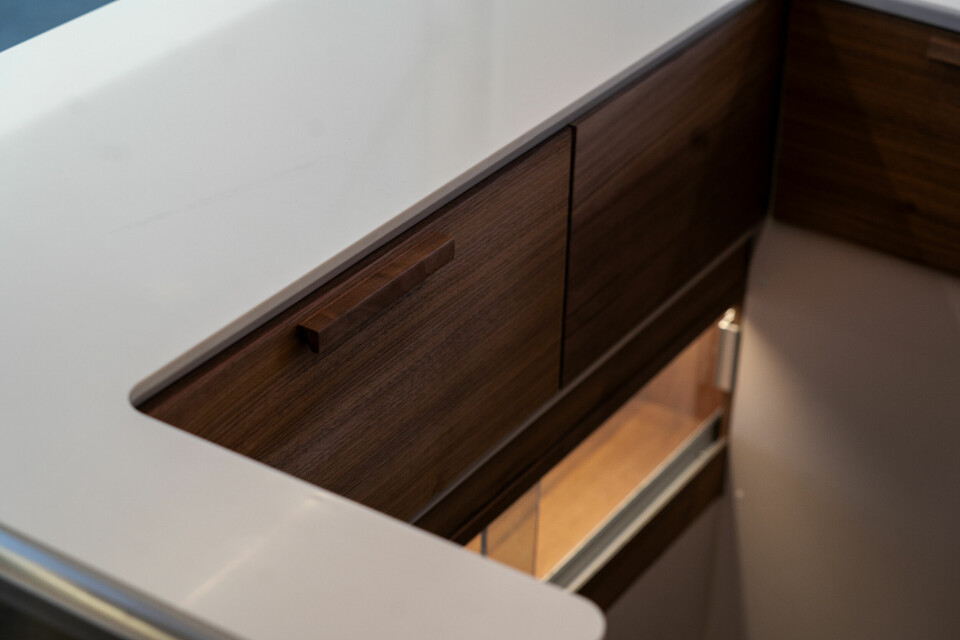
That interior, and many of Grounded’s RVs for that matter, use recycled plastics and homogenous panels that are affordable and easily customised. And crucially, look good with minimal surface finishing. “The beauty in that is you can carve into it a kind of marble,” notes Meyer, “and therefore we can integrate the handles and skip any kind of edge treatment. We’re basically machining it on a CNC and it's ready to mount. Nobody in a commercial outfit has really ever focused on these types of homogeneous materials; we’re also experimenting heavily with different forms of aluminium and composites.”

As the conversation goes on, we had to remind ourselves that this is a discussion around commercial vehicles, not domestic interior design. The execution and layout of these spaces – which fit neatly in the back of a truck or van – feels so far from the usual cold, grey storage tubs we are used to seeing. It is the approach to materials yes, but also the structure of the zones.
“We spend a lot of time doing ergonomic studies around the workflow, how different people will be moving around the space – especially in food, which is very speed-oriented,” says Meyer. “We have quite a few coffee franchises and although it's a tight space we need to make them feel comfortable. As a human-centric industrial designer all this is super empowering. It's like a world-building exercise where you get to design somebody's day – be it in coffee, healthcare or even education.”
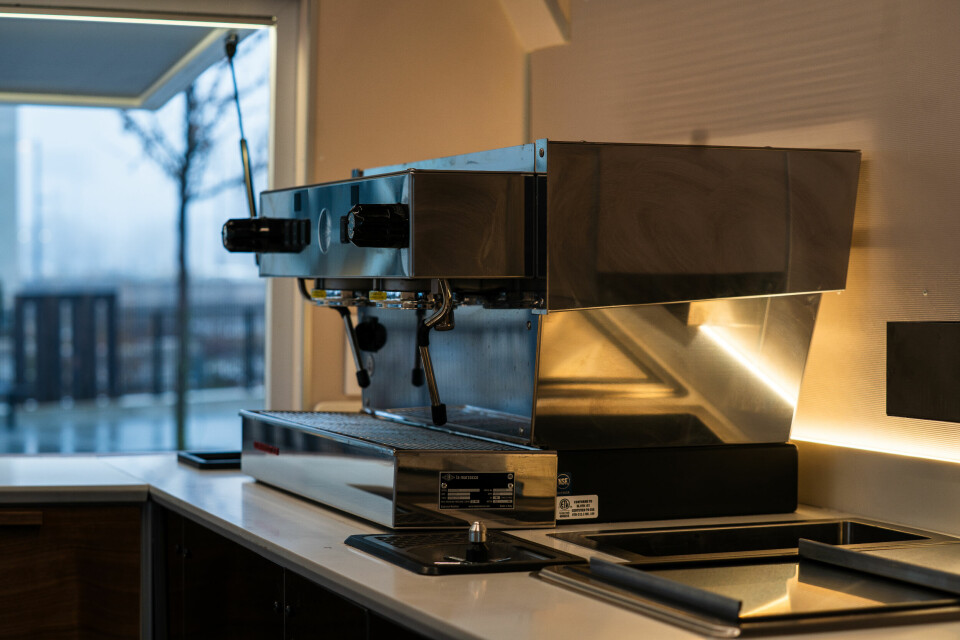

Indeed, a couple of education units have been shipped to a customer in Arizona where pop-up tech schools show kids (and adults) how to use emerging technologies. “They need it to feel very welcoming, cozy even,” says Meyer. “We chose these bar stools and a warm interior. But remember, it's alphabet-based, so it's not a tailored 'whatever-you-want' design. It has to come from our library and we have to be able to manufacture quickly.”
While it is simpler than it could be, it is not simple. Meyer and her compact team have plenty of intricacies to consider, ensuring every drawer slides smoothly and built-in units survive the vibrations of a working vehicle. In some cases lightweight composite aluminium Dibond walls offer strength and durability, while acoustic panelling makes use of recycled PET bottles; both solutions are part of the Gounded material alphabet used for other projects. “The challenge is to design an alphabet that can infinitely recombine in any kind of layout,” emphasises Meyer.


It is easy to see why the commercial vehicle market at large has never been able to replicate this kind of activity. While Grounded is apparently seeing strong business in its first few years of operation, the kind of volumes at hand pale in comparison to the likes of the Ford Transit upon which many of its vehicles are based: in the US alone some 161,797 Transits rolled off the Kansas assembly line in 2025. Customisation at that kind of scale is nigh impossible without a boost in resources to match.
But by working with individual customers and curating a materials library that can be easily adapted for a variety of use cases, Grounded seems to have cracked a niche that could very well bring an exciting CV to a town near you.
(Ed. At IAA 2026 in Hannover it seems that many big name manufacturers are beginning to strengthen their CMF offerings across van, truck and bus. An industry trend appears to be building)