Truck design
“Our task is more an architect of a tiny house” – the secret of truck interior design

Fundamentally, truck interior design strays from the world of car design in its form and function but there’s a lot we can learn from this hybrid design task
“Commercial truck design exists at the intersection of traditional automotive design, residential interior design, and industrial product design,” explains Austin Cox, design manager at Mercedes-Benz Truck Design Studio. Whether it’s sleeper cabs, day cabs or robust cabs designed for construction and off-road work, truck interiors are the ultimate multi-functional space.

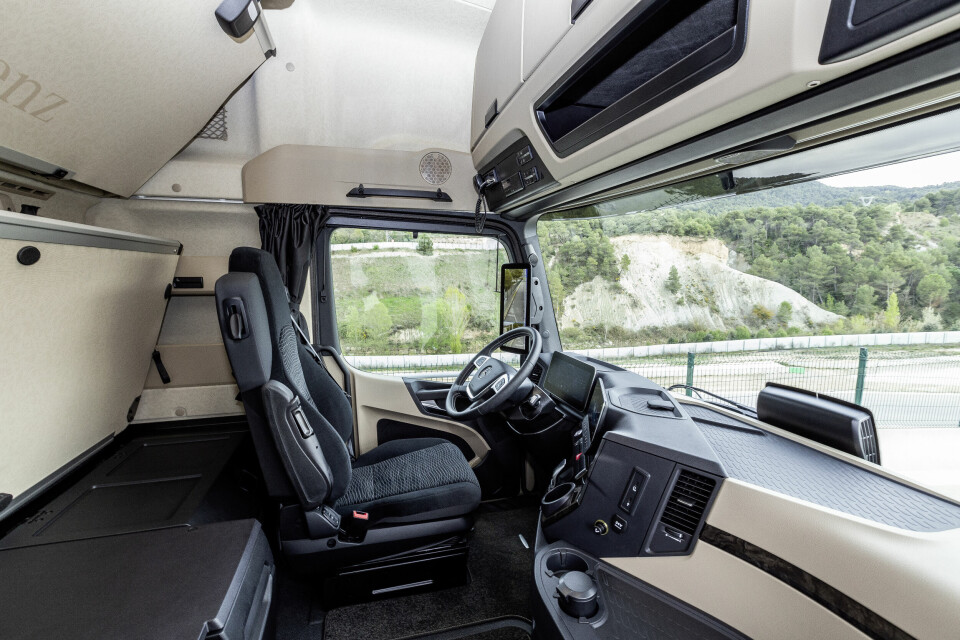


Bart van Lotringen, design director at DAF Trucks says, “Our task as designers is to combine all these functions of driving, working, resting, sleeping, eating and storage of goods together in the best possible way.” Add into that the fact that trucks typically cover around 1.5 million km in less than 20 years and durability, robustness and timeless design all play an important role in the final product.
“Also a driver is often not the owner of the truck but the one that is living with the vehicle, not only in terms of living inside the cab but has a direct relationship with the vehicle, it’s part of their identity. So, it’s also one of the most customised and personalised vehicles on the road,” adds Marco Armigliato, head of Iveco Design Centre.
While interior design is an iterative process, the fundamentals start with establishing a good layout. Van Lotringen says, “We use low resolution prototyping to visualise and to be able to experience new ideas. We do that assessment together with drivers. We build something very quickly out of plywood and cheap materials so we can have a discussion about what works and what doesn’t and move on quickly.”
In the case of sleeper cabs, once designers have defined three distinct areas for driving, resting and sleeping, CMF is where the key differences appear. “If you look back 20 years ago, all the interiors were grey and dark blue but that has completely transformed in the industry since with a focus on warm colours and comfortable materials,” van Lotringen comments.


MAN has taken this concept one step further and internally repositioned CMF as CME with the ‘E’ focusing on experience. Carolin Schütt, CME design lead at MAN explains, “Experience includes everything we perceive, see, feel and more, we design with that holistic lens. The cab is a tiny house so we always try to keep the areas where dirt is in dark colours and as it gets higher in the cab we try to make it lighter to get that feeling of space.”

Considering the interior as a living space, Cox says, “Every surface a driver sees, touches, and interacts with is of high importance to us: the color, the texture, the gloss level, and the tactile feel. It all begins by defining the desired ‘mood’ or ‘ambiance’ we’d like to convey on a conceptual level.
“This philosophical foundation then guides the selection of materials that consistently support and reinforce that target ambiance. With that vision in place, we select materials that work together to create a cohesive atmosphere, whether that is calm and residential, bold and technical, or confidently-professional.”
These decisions are still firmly rooted in practicality and meeting the demands of the job though. Van Lotringen notes, “What is very different between cars and trucks is that truck drivers wear safety jackets and these safety jackets usually have velcro. These little needles are terrible for the material, they can really damage it, so we have to consider how to make the material withstand that but still feel comfortable, it’s a difficult balance to achieve.”
This principle is the same when it comes to selecting materials for high touch points. Armigliato says, “Some very rough materials may be the best choice for a day cab or off-road truck user but on long distance trucks it’s wrong. We need to think about perceived comfort as well as how easy something is to clean and its scratch resistance.”


As new, more sustainable, materials start to become available, truck manufacturers are carefully considering how to reduce their environmental impact, maintain high levels of durability and deliver what customers want. Schütt explains, “We try to make sustainability visible in a smart way while still meeting functional requirements. That can mean reducing layers, simplifying constructions and pushing toward mono-material solutions to enable circularity.”

However, Schütt is keen to remain realistic about who their customers are. She adds, “When it comes to leather, for example, we don’t have vegan yoga drivers so much, so because drivers tend to be more conservative, we’re going to stay with leather. We will change toxic processes like galvanisation, minimise many layers of material and look at parts that can be recycled.
“We’ve decided not to approach sustainability in a missionary way. I always compare it to, for example, if you go to a truck stop and look at the shampoos, they're often caffeine or hops shampoos. Now, we’re in contact with some suppliers for hops textiles, so that’s something where drivers could think having a beer textile seat would be cool. It’s got to be smart and funny without being too missionary.”
Whether it’s collaboration with suppliers or other areas of the business, truck interiors rely on diverse input during development. This is especially apparent in HMI as Cox explains, “We begin with rapid, low-fidelity wireframes and progress through targeted UI design studies, interaction models, to fully-defined user flows. Our workflow relies on deep interdisciplinary collaboration: UX/UI designers, ergonomics experts, human factors specialists, and engineers work closely throughout development.”


Van Lotringen adds, “HMI is becoming more important, not so much by adding more infotainment but more about how drivers do their job. The digitalisation of the job affects the interface for the driver and it becomes very important that you have an intuitive and easy to understand interface because it matters in terms of safety, comfort and even ergonomics.
“Drivers might not always be in the same truck, so if they move from one truck to another, they have to understand what they’re seeing. We spend a lot of time designing clear symbols that represent the action of what’s happening so there’s no confusion.”

With the widespread adoption of mirror cameras, advanced safety assistance systems and fuel efficiency technologies, Armigliato argues trucks and drivers are more connected than ever. He explains, “There is a stronger connectivity level. The truck is connected much more than what we see on cars. It’s connected to the logistics hub, the workshop, the company. The driver is continuously interacting in a digital way.
“The driver needs to evolve with this increasing complexity but the design of the truck, especially the interior, needs to follow that to be able to balance this workload complexity in a way that allows the driver to still enjoy driving the truck.”
Cox agrees, “While every manufacturer strives to develop a unique form language and brand expression, the common thread is that truck interiors are becoming more connected, more adaptable, and more operator-centric than ever. We see rising expectations around integrated technology, modular storage, and enhanced comfort and safety features.
“Today’s trucks are modern, sophisticated, highly-capable products, and operators rightfully expect the same digital convenience and comfort they enjoy in their homes and personal vehicles. In the design studio, we routinely work on vehicle concepts that may enter production five, 10, or even 15+ years in the future. Understanding today’s drivers is essential, but our ongoing challenge is to anticipate what drivers will need beyond the needs of today and into the future.”