Rivian design boss on holistic design
"Every touchpoint should feel like it's from the same company"
Rivian's head of design explains why he views the digital ecosystem as part of the brands broader design language

The modern car designer’s job spec has evolved immeasurably since the early days. Once firm boundaries between departments have softened to a point where expressions like ‘multi-disciplinary’ are no longer buzzwords but a fair reflection of how designers are working.

At Rivian, the team-at-large has been steadily evolving its vehicles but also the ecosystem around them, from smartphone apps to digital interfaces at customer-facing settings like dealerships or pop-ups. Head of design Jeff Hammoud spoke to CDN about ‘doing more’ and why a cohesive design language comes down to more than light signatures or body surfacing.
Car Design News: Do you find yourself getting involved in more areas beyond conventional ‘car design’ these days?
Jeff Hammoud: Probably more so, I get a lot more in engineering just because of the nature of Rivian and how long I've been here. I don't know if that's pretty typical, but yes, things that are not definitely in my job description, but it's fun.
There are many different touchpoints that we get pulled into, and they all need to look and feel holistic
CDN: Based on your recent work, part of that now includes app design, apparently. How has that been for you as a car designer by trade?
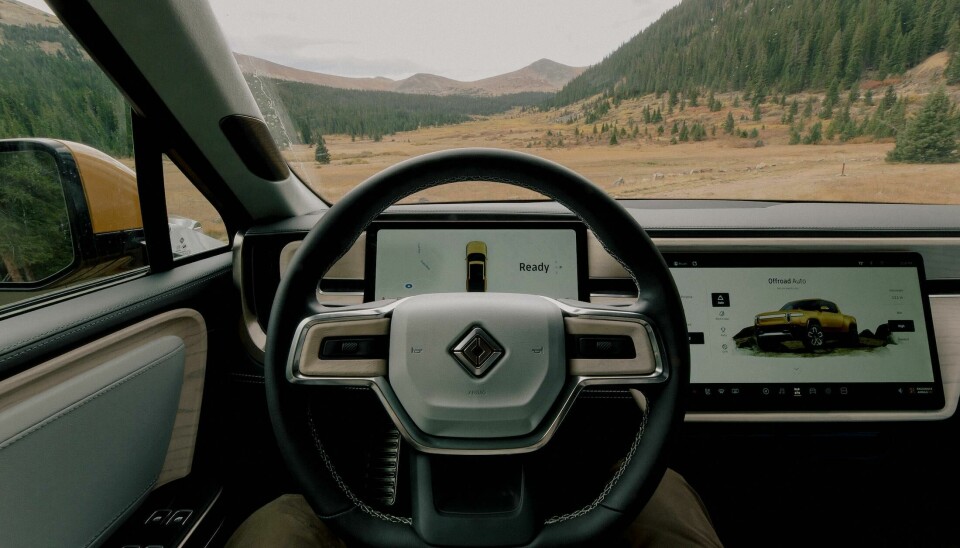
JH: It's fun. We created a Rivian design system that we could use across all digital ecosystems, and that’s something that I really pushed for and it's been that way for maybe the last three years now. We redesigned the website quite a few times, for example, and that system touches a few different levels. One is the software integration of our products, which is a big enabler for us that provides us things where we're able to move quickly and get all of these points connected. And our mobile app is a big part of that experience.
There's the vehicle-centric controls but it also does a lot of other things which needs to connect to our commercial and service teams. You literally schedule your services through the mobile app. When you're purchasing a Rivian vehicle, the app is where your reservation is. Because we're direct-to-consumer, we really need our digital tools to work a lot harder. They're not only for attracting customers, they're for customers that are in the pipeline and those who own the product.

We also connect that with a lot of the tools we do inside of our spaces. So if there's digital tools to communicate how the vehicle works, we design bespoke apps in there. For example, we have one that allows customers to enter their address and show trip planning so they understand where they can charge to take away a lot of the range anxiety some people still have. There are many different touchpoints that we get pulled into, and they all need to look and feel holistic, which is on the design side, but more importantly, how does the UX feel connected between all of them?
CDN: For a lot of Rivian owners, their first touchpoint with the car is going to be through the app, so by the time they receive the car they're already quite familiar with that UX.
JH: Exactly.
CDN: Unlike the car, once the app has been built it becomes a continuous project that can be updated across its lifetime.

JH: Yeah, it keeps growing. We do a software update every month already, so there's new functionality going into the vehicle every month. That's something my team is constantly working on – you're never actually done. We're still doing things for the first generation R1s because it's a big part of being a software-defined vehicle company. We say that the least capable version of a Rivian you buy is the one you buy today, because as you own it, it's only going to get better and better.
CDN: You have suggested that the digital ecosystem can be considered part of a brand's ‘design language.’ Why is that?
JH: I think it's really important. You want every touchpoint to feel like it's from one company, viewed through one lens, with a cohesive design. A consistent design language. We want to create something that's functional, easy to use, but also expressive. And that's like the hardest part.
CDN: Will there be different iterations of the app for each model? Or one universal app?
JH: No, it'll be one unified app. If I look at mine now I can see different cars, charging status, my R2 reservation. Everything's in here.

CDN: This all falls into the wider idea of holistic design. What does that mean to you in practical terms?
JH: It’s funny, I was speaking to Jony Ive about how Apple had so much consistency. But he said – and this is why I don’t use that word anymore – “we didn't aim for consistency, we aimed for cohesion.” Consistency can be stale or boring, whereas cohesion is about a through line across the vehicle, the app and our spaces, many different things.
And there are totally different ways to do that. It could be through form vocabulary, it could be through colour, through materiality, the digital system. You may not be able to explain it, but you know you’re in a Rivian space. It evokes an emotion. And a key thing for our brand is the idea of being inviting.
CDN: How is that reflected in your design language?
JH: It doesn't mean everything needs to look the same, it's more about the overall ethos of the brand. We also like to add a little bit of playfulness too, for example the little Yeti character in the vehicle and the app. It was a very conscious decision: if you don't know anything about the brand and you see this, you'd smile. All these little interactions we can do that are almost silly sometimes, just like it’s silly that a 7,000-pound truck can do the quarter mile in 10 seconds. That’s silly but also playful. We don't want to take ourselves too seriously.
People form an opinion on the exterior very quickly. After that it's the experience, and that’s where we bring in thoughtfulness to the design
CDN: So it is less granular than the traditional considerations around surfacing, lighting etc. and more about designing a feeling, so to speak? Is that cheesy?
JH: We can’t really say it’s inviting because of this radius or how we've drawn this line and approached the surfacing. I'm an exterior designer by heart, that’s why I started and is where my passion is. But people make up their mind the second they see the exterior – either like it or they don't. They might look around and start to appreciate it more and notice details or nuances they didn't see before, but they're going to form an opinion very quickly. After that, it's the interior, it’s the experience, the drive. And that’s where all of these little stories that are fun to tell come in – it’s where we bring in thoughtfulness to the design.
CDN: It’s refreshing for an exterior designer to say something like that.
JH: All of the conventional considerations are super important, don't get me wrong. But if you get locked in to particular shapes, you eventually ask: how do you avoid becoming stale? And if you tie in your design ethos to a surface language or a form vocabulary, it becomes very difficult [to avoid that]. Looking at the R2 I think the silhouette is important, a very horizontal hood, the fast windshield and the very two-block silhouette. And then our stadium shapes work at whatever scale they are. We're nowhere near as iconic as a 911, but it’s a good example: the round lights, a silhouette you can put a sheet over and everyone knows it’s a 911. How can we create some of that?