How good is the latest Kia?
Design driven: Kia EV4 – Fastback vs Hatchback
Guy Bird drives both the Hatchback and Fastback versions of the Kia EV4 to see which he prefers
It’s always a pleasant surprise to occasionally interrupt the endless flow of mid-size production SUVs with something conceptually different. And Kia’s design team did just that back in February 2023 at its Korean design centre at a ‘no photos’ media preview of future vehicles.


Out of the accomplished handful of (mainly) full-size crossovers shown, the one that stood out most was an elongated sedan-cum-fastback named ‘CT’. Still yet to sport an interior it was later wheeled out as the EV4 Concept at Kia’s annual EV Day in October and the 2023 Los Angeles Auto Show just afterwards. During early planning for the Car Design Review X yearbook the EV4 quickly made the concept car shortlist and among strong competition eventually scooped third place in the 2024 CDN People Awards Concept Car Design of the Year awards category.
Looking through my notebooks from 2023, I jotted down that Kia designers believes the sedan model would mainly be for the US and China markets with a hatchback version with a more truncated rear end aimed at Europe. But luckily for the sake of vehicular variety Kia’s management was feeling bold and ended up offering both EV4s in Europe – with the sedan rebranded as Fastback – and in right-hand-drive for the UK market.
Forward-wind to early 2026 and it seemed only right to drive both the Hatchback and Fastback versions of the EV4 to see which works better in real life, while also evaluating whether the conceptual dream of 2023 – as embodied in the fine exterior sketches of Byoung Oh Choi – remained intact in production form.


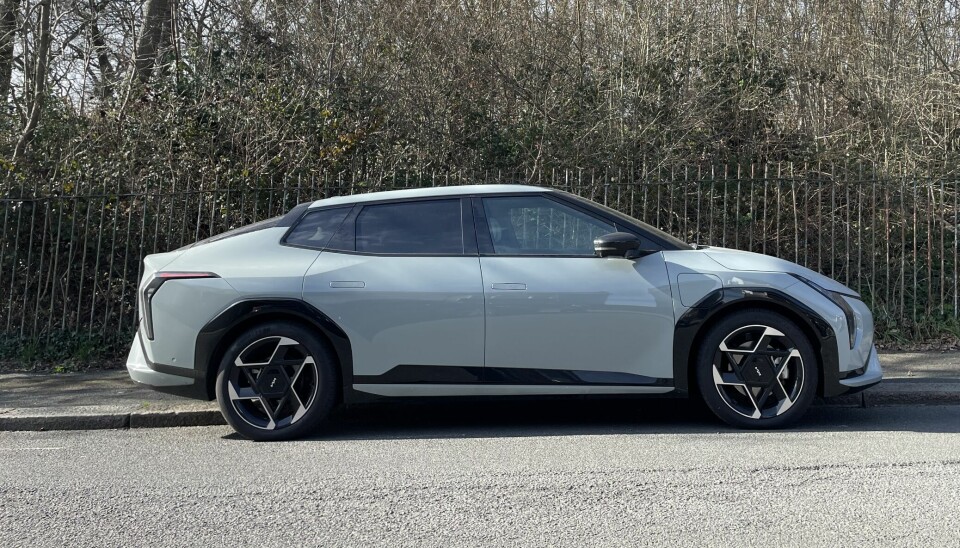
To answer the latter question first, the production Fastback still looks great in the metal and on the road and is super close to the concept in form. Yes, there are a few more shut-lines – above the front wheel arches and to create the filler cap – and the full-length panoramic roof has made way for a shorter one upfront, but the basic proportions, stance and graphic details have stayed true to the concept.
Design industry watchers are one thing, but what do members of the public think? Again, both the Fastback and Hatchback received a lot of love on our extended back-to-back test, and from unlikely punters – who weren’t asked – but felt compelled to reveal their thoughts anyway. Like the little old lady who sidled up to the EV4 Hatchback in a far-from-fancy south London car park and said, “I love your car,” before asking what it was and proceeding to pronounce it “futuristic” (in a good way).
Of the two, the Hatchback is the more familiar shape within European markets dominated by the VW Golf and Ford Focus in recent decades before compact SUVs took over – and Kia UK expects to sell four times as many of them as the swoopy Fastback – but both models stand out as modern and distinctive pieces of exterior design. Sometimes in rear three-quarter view, or even directly rear-on, the Fastback can look a little bulky, perhaps because the boot line is so high – and that’s reflected in a rearward driver view that is limited because the rear windscreen is shallow – but that element is also part of its exterior appeal too.
In terms of dimensional difference, the EV4 Fastback is a considerable 280mm longer than the Hatchback equivalent (4730 vs 4450mm in GT-Line trim), the same 1860mm width and 2820mm wheelbase, and just 5mm lower (1480 vs 1485mm). The Fastback’s extra length contributes to a large boot of 490 litres (vs the Hatchback’s 435 litres) but both versions enjoy excellent and comparable rear seat space, with the Hatchback offering a bit more headroom (963 vs 944mm).


Upfront, space is also great, with a light and airy cabin helped by a dashboard with no inward curves towards either A-pillar or indeed the centre console area, that might create a sportier cockpit feeling. The horizontally aligned narrow rib, artificial leather seats are comfy and smart-looking too, and the unusual front headrests functionally distinctive. Featuring a mesh which feels delightful to rest against, these partially see-through headrests also create a greater sense of space in the cabin compared to conventional solid ones. It’s simple detail, but works well. As does the now ‘signature’ Hyundai Group rear-view safety vision feature, that appears on the driver cluster screen as a circle of real-time video when the indicator for left or right is activated and shows the road behind for the appropriate side of the car.
On the GT-Line S trim Fastback, one slight negative is the automatic rear-sliding front seat function for entry and exit. Apparently, it can be switched off, but the unsolicited motion has freaked out more than one passenger readying to get out of the car and then feeling like the whole car was sliding back – perhaps because the driver hadn’t put the hand brake on (I had). That something designed to add a layer of ease had the reverse effect is a shame.
One other small interior negative is the lack of rubberised flooring for the multiple storage areas. As a result, keys and any other clunky paraphernalia, tend to rattle around rather noisily. I don’t know how much it costs to add a rubber mat to each storage area on what is the top GT-Line S trim – but it can’t be much – and should be sorted.
The combined twin 12.3-inch screen layout for driver cluster and central touchscreen infotainment perched on the dashboard is neat but the wider UX start-up process is too long-winded. On approach, the flush door handles flip open, recognising the key in your pocket, but once in the driver’s seat, an ‘EV On’ button – on the same fat stalk behind the steering wheel as the auto gear selector – has to be pressed and then there’s a tedious greeting via the central display confirming you’re a guest driver or otherwise, after which you can finally press ‘Start’ on the central touchscreen and get going. It’s also almost essential to press the ‘star’ button on the steering wheel to shortcut to the safety menu and turn off various warnings that will start bleeping almost instantly otherwise. Forward vision alert is the one to switch off if your eyes even occasionally stray from looking straight ahead and the chime to chide drivers for doing 22mph in a 20mph zone is equally hard to avoid unless you switch off the speed limit alert completely.
A pair of safety alerts I do leave on relate to speed cameras. On the approach to a speed camera, you hear one noise and once passed it there is another lower-pitched version. Unfortunately, it’s a very peculiar pair of sounds – akin to the doorbell made famous in the Avon lady advert, which no doubt dates me – but neither seem sonically associative as warnings to take seriously. To my ears they’re just odd. On the more positive side, when you approach a speed camera going faster than the speed limit, the miles per hour number reading on the driver cluster changes to amber or red, until you slow down, when it goes back to a lighter colour. This visual as well as audible signal is good graphic design (and better UX).
One last small negative: the centre console’s backlit touch-sensitive embedded buttons for Media, Setup, Map, et cetera may seem slick, but in certain lights, are hard to see. So much so, their lightly lit words can get lost against the cream centre dashboard fillet, which isn’t helpful, especially on the move.
Once you’ve got the boings muted – or at least reduced – driving the EV4s is easy work. All versions are front-wheel drive, 204hp single motor models that are smooth in acceleration (7.9secs 0-62mph), with gently weighted steering and well-damped suspension largely masking outside road imperfections, despite 19-inch alloys. The EV4 Hatchback range starts with a 58.3kWh battery but both cars tested featured the bigger 81.4kWh long range battery pack for 362 (Hatchback) and 380 (Fastback) miles of range, the latter model’s lower roof and longer tail helping to contributing to those extra electric miles eked. Indeed, with a drag coefficient of 0.23Cd the EV4 Fastback is Kia’s most aerodynamic EV ever (while the taller Hatchback posts a still very good 0.261Cd).
These cars may wear a formerly value-led automotive name on their bodies but they are now competing with upper mainstream-to-premium level EVs. The Kia EV4 GT-Line Hatchback only costs £39,445 and the higher-trimmed EV4 GT-Line S Fastback £45,445 which buys a lot of kit and car. When both were first revealed, from afar, I was underwhelmed with the Hatchback variant believing it to be too safe and obvious. But up close it has way more presence and flair than rival existing hatchbacks (including older Kias).
However, the Fastback is still the version that holds most interest to me and despite its bolder looks – that even Kia’s head of design Karim Habib admits are “polarising” – received a warmer street crowd reaction than I was expecting. Yes, it has a less functional boot – the Hatchback’s tail is simpler to get things in and out of – but the Fastback has a visual modernity that is seldom matched in the wider car parc. As Habib concludes: “What’s fascinating is that these EV architectures have flexibility that allows us to do these things. The EV4 Fastback was part of the thinking that there should be, as we move to a new era, vehicles that symbolise it.”