Mechanical simplicity: REO promises 'rational' new work truck

Another historic American nameplate returns with roots that date back to the early 1900s. Frank Stephenson explains why the Runabout does more than rely on nostalgia

There is a new player in the affordable utility vehicle game. Rather than an electrified, software-defined and automation-ready device, the REO Runabout relies on a tried and trusted format: simple design, ICE power and a variety of body options from single and twin-cab truck, dropside flatbed and two-row SUV.
Design comes from the studio of Frank Stephenson, which was enlisted by the Dallas-based founder of REO Trucks, established this year as a direct revival of the original manufacturer led by Ransom E. Olds (of Oldsmobile fame) in 1905. Vehicles including the 1915 Speed Wagon, which REO describes as the "ancestor of the modern pickup truck" rolled out of that factory in Lansing, Michigan through to 1975.
There is plenty of heritage to draw from and certainly the opportunity to tug at the heart strings, but Stephenson and co. are keen to avoid retro interpretations and instead channel the mentality that kept REO in business for seven decades: affordable vehicles that work, can be easily repaired and character that makes it feel like part of the family.

Visually, the face of the REO evokes themes of 'classic' squarebody trucks with a strong upright grille, defined headlamps at each corner that are neither imposing nor meek. Friendly, but also capable and hardy. "Our ambition was to capture the character and spirit of the American bison — its strength, confidence and unmistakable presence — while drawing upon REO's heritage of rugged durability and mechanical simplicity," Stephenson explains. "The result is an expression of those values through intelligent, contemporary design."
The bodysides are exceptionally clean with linear creases along the upper and lower character lines, almost like hand fabricated sheet metal. We assert that this may — consciously or subconsciously — serve as a nod to the truck's blue collar roots, a truck for makers and doers, but Stephenson tempers that idea. "I would be cautious about associating simplicity with blue-collar ideals; that risks becoming a rather self-deprecating design strategy," he says. More accurately, that surfacing is just another reflection of the goal for simplicity, to avoid unnecessary flair. This of course is where heated debates arise around design versus styling.

Instead, Stephenson and his team clearly want to communicate that combination of form and function. The creases in the bodysides in fact add stiffness to the panels, and those square LED headlights can be sourced "off the shelf" and easily replaced by owners. As can the arch extensions which can be unbolted without fuss. All very useful for the inevitable scuffs and scrapes a truck like this will wear after years of service to business and family. The Runabout is not a caricature of 'blue collar life' but a product that embodies a seemingly dying expression: built to last.
"Very few vehicles in automotive history have transcended social and economic boundaries to become genuinely democratic objects of desire - vehicles people admire not because of who owns them, but because of what they represent," he explains. "That's precisely the territory we want REO to occupy. The surfacing has been carefully developed to achieve that balance of simplicity, purpose and refinement."


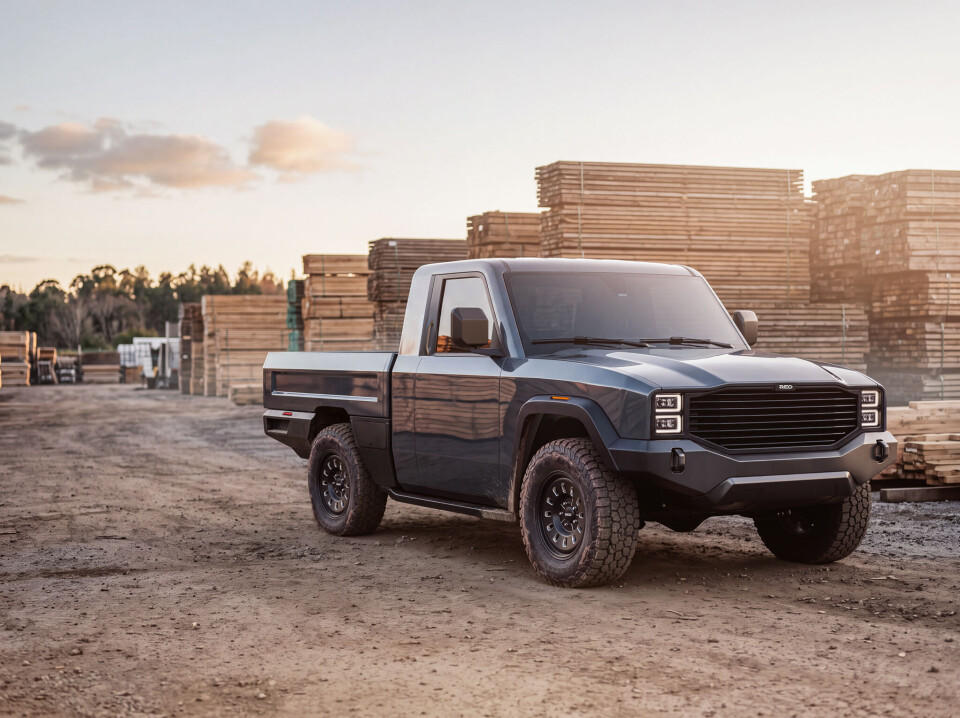
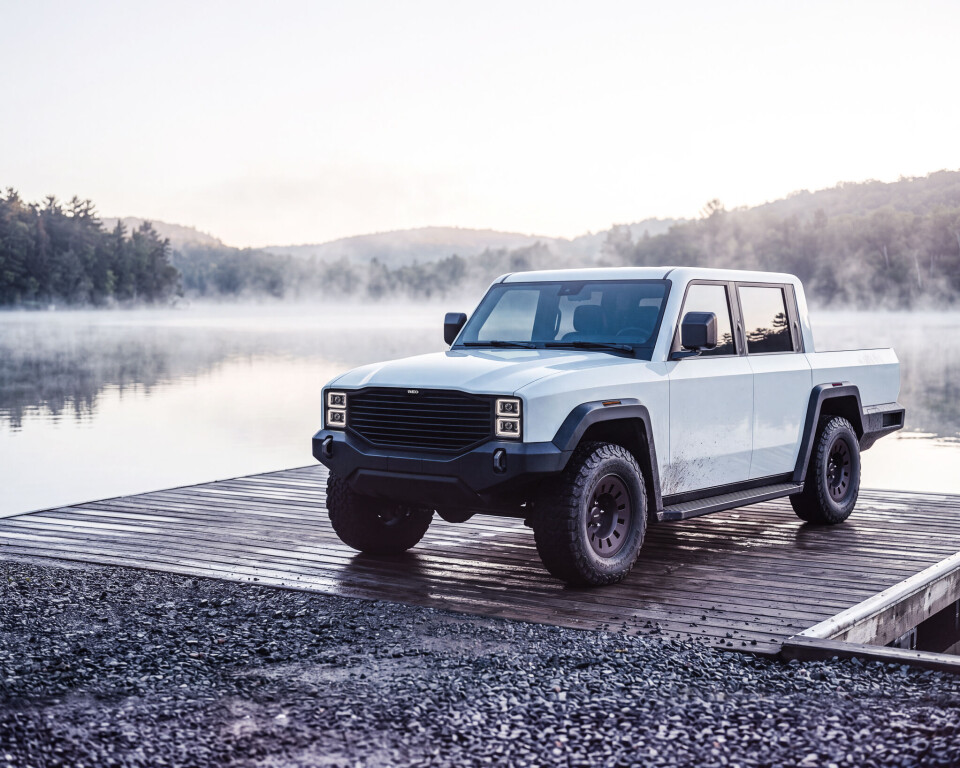


There are three core variants: the T4X work truck, T4C crew cab and S4C family SUV. All bear that familiar front half but give the freedom of choice to potential buyers. Renders provided include visions of those various strains at working farms, vast deserts, snowy mountain roads and lakeside camping spots. Mud splashes where appropriate.
"People have been asking for this truck for a long time," says senior designer Sajay Shinu. "They remember the pickups of the 1980s and 1990s, trucks you could drive deep into the woods knowing that if something broke, you could fix it yourself with what was in the back. They want that confidence again, just in something new."
Similar principles are found inside, although we do not have and artwork for that just yet. On the UX front at least, physical controls are apparently sturdy and chunky enough to be used with gloves on.

When we first saw the press release it seemed that REO was gunning at a similar market as Slate Auto, another American upstart with plans to offer an affordable work truck/family SUV combo with a simple design aesthetic. The Slate should retail from around US$25k (deliveries currently promised in time for Christmas 2026) while REO's Runabout should range from US$21,500 to US$28,500 depending on the variant. But that is where the similarities end.
“The two vehicles are fundamentally different in both philosophy and intended market positioning,” says Stephenson. “Slate is an electric vehicle built around its proprietary Slateboard architecture, seemingly aimed at the urban technology consumer. REO takes a very different approach: traditional internal combustion power, a body-on-frame architecture and a strong commitment to the Right to Repair principle. We weren't designing against Slate; we were defining what REO should be.”
In an abstract way, the notion of Right to Repair presents an opportunity to strengthen the bond between car and driver. The owner feels empowered and (with the parts catalogue and repair manual available) confident in fixing a least minor issues. Yes, it is more affordable in a practical sense by avoiding costly certified repair centres, but it switches the dynamic from 'this is something I'm borrowing' to 'this is ours.'

Anyone who has spent time working on their own vehicle will profess a sense of pride in looking after it — a shot of the whole family around the campfire, dog and car included, does well to illustrate this. It is no coincidence that Willys Jeeps and Series Land Rovers are still so popular today — repairability is a design superpower that has quickly gone out of fashion.
REO says that the bumpers, door cards, headliner and trim should come off in under five minutes using only common tools. And in theory, a turbocharged in-line four mated to a six-speed manual or automatic transmission should also be within the realms of self-maintenance for plenty of owners.

The initial design phase began mid-2026 and will be refined through the course of next year. The first prototypes will be the T4X work truck at some point in 2027, with deliveries around late 2028 to early 2029. The T4C (crew cab) and S4C (family SUV) will follow after. What is Stephenson's favourite configuration? "As the proud owner of a Bernese Mountain Dog and a TF 450-X [motocross], my personal choice would undoubtedly be the T4C. Naturally, it would have to come equipped with the Ransom Package!"
The idea and visuals behind the new-look REO are promising and laudable. But history would serve us well to take any projections with a pinch of salt — not everything goes to plan and we have seen countless start-ups with fantastic ideas struggle to break ground. Alpha Motors first showed the compact 'Wolf' pickup in 2021 but is still only available to reserve. Lordstown Motors had the backing of an enormous Chinese tech giant Foxconn but started production nearly three years later than expected and fizzled out not long after. Will today's pace of design and an off-the-shelf powertrain give REO a better chance at success? Time will tell.