Autonomous vehicles
Designing autonomous luxury at Lucid

Lucid Motors' design supremo Derek Jenkins explains how autonomous driving reshapes vehicle design, user experience and luxury expectations, outlining the balance between tech innovation and human-centred creativity in future mobility
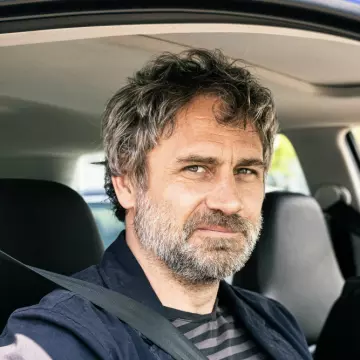
Though the more hawkish among us predicted that autonomous driving would already be here, it has not yet materialised. However, all signs point towards a future where eyes on the road and hands on the steering wheel may not be necessary. In this interview with Car Design News, Lucid Motors SVP of Design and Brand Derek Jenkins discusses the evolving role of design, the importance of trust and user experience, and how luxury brands must rethink vehicles for a connected, driver-optional future world.
Car Design News: Level 4 autonomy is becoming less science fiction and more a reality you can work towards. How much of it is a design question as opposed to a tech question?

Derek Jenkins: I think it's a combination. Even looking at our next midsize platform, we've been trying to enable more technology in the car, not solely for the passenger, because we see this opportunity as we move towards a Level 2 hands-off and even eyes-off, and then eventually a Level 3 mind-off scenario. It opens up a lot more opportunity for entertainment and productivity inside the car for both driver and passenger. At that point it does become more of a design issue, rather than just a tech issue.
CDN: And to that end, where do you think designers are likely to have the most influence? Where are you seeing the most opportunity?
DJ: In the near term it's mostly going to be about existing platforms. In our case, Gravity has really great applications for rideshare fleets. You're already seeing that, where rideshare platforms are utilising existing cars, like what we're doing with Uber and the Gravity.
Then it's about integration and retrofitting additional components to enable that. In the Uber relationship the interior stayed relatively unchanged, except for a few minor things in the centre console, because the car is already well suited. So in the near term you'll see more of this civilian vehicle being uplifted for rideshare applications.
We're in an automotive nostalgic phase, especially among luxury buyers and enthusiasts
Long term, as you get into a purpose-built vehicle where you're really challenging the status quo of pedals and steering wheels, you start asking what the seating position and orientation should be. How do you utilise the space differently since it's never meant to be manually driven? That's where it unlocks interesting discussions about egress. Is the vehicle divided into independent spaces, or is it still communal? Is it van-like for multiple people, or a two-seater, or even a single-passenger vehicle?

Looking five, 10 or 20 years out, you can imagine the natural evolution of the automobile shifting drastically for that specific application, and that gets quite interesting.
CDN: This is particularly interesting as it pertains to Lucid. What does autonomous luxury mean? You can define it in many ways: convenience, serenity, productivity, or more of an emotional pull.
DJ: Ultimately it's about giving time back, whether it's a personally owned autonomous experience or an autonomous rideshare experience. It's about preserving time for the user.
So I see that as the intersection for privately owned vehicles. That's where we would play: to optimise, and even humanise, what an autonomous connected car experience can be. With continued advancement of AI, voice recognition and agentic engagement, there are a lot of opportunities to create a really branded experience. Long term, that's probably where things are going.
In a Lucid, I can go hands-off, but I'm not supposed to be eyes-off, and certainly not mind-off. You're in a strange limbo where you end up on your phone or checking emails and thinking, I shouldn't be doing this. It's a weird state
CDN: Do you think there are aspects of contemporary, or even traditional, automotive luxury that will become less relevant as we move on?
DJ: Certain things, aspects of materiality and the romance and nostalgia legacy of luxury, will always be there in some form. We're in that phase right now, where things have moved forward so quickly over the last five to 10 years that we're in an automotive nostalgic phase again, especially among luxury buyers and enthusiasts.
We saw that at the end of the 80s and the beginning of the 90s, where there was a reset towards nostalgia. I think we're going through that again, and it reinforces what is eternal, timeless and valuable as technology continues to push and shift the automobile. Some things will stay and remain part of the mix, while other things are hard to predict.

CDN: Sometimes I think we underestimate how much a technological change opens up the field for design. We tend to look for moments of creative inspiration, but normally what happens is a patent gets filed.
DJ: I really feel like we're going to look back in 10 years at some of the discussions that go on in enthusiast forums and think, what were we talking about? It's ridiculous.
But I do feel we're at a very special moment in time. It's a matter of watching how the technology evolves, watching how consumers adapt to it, or recoil from it for a period of time, until the technology becomes so superior that everybody accepts it. Let's not forget there were smartphones on the market for five years before the Apple iPhone came along, and most people thought they were ridiculous. Now the notion that you held on to your flip phone seems insane.
The electric car and the autonomous vehicle will get to that point where it would be like riding a horse for primary transportation in 1940 or 1950. It would have been unthinkable.
CDN: On a practical level, how do you communicate trust to people via design?
DJ: Some people innately have faith in technology, and others don't. There's a lot we can do from the in-car experience. We can provide clearer and more understandable displays of what the car is seeing at any given point in time. Up until now, the basic ADAS experience has been pretty generic, but what the car can actually see is really detailed. How do we display that, or offer to display that, so people feel reassured that the car sees what they couldn't possibly see and can react accordingly? There are opportunities there to bring reassurance.

But there will still be a degree of trust and handoff. Once people get used to it, the benefits of sitting back, relaxing and switching off will be really compelling. Right now we're in that in-between phase. Even now, in a Lucid, I can go hands-off, but I'm not supposed to be eyes-off, and certainly not mind-off. You're in a strange limbo where you end up on your phone or checking emails and thinking, I shouldn't be doing this. It's a weird state.
We also have our advanced engineering team working directly with us as partners early in any project until the concept phase is evaluated and solidified, and then we take that architecture through feasibility
Once we get over that and reach a true mind-off scenario, like a proper Level 3 and ultimately Level 4, there's a lot of freedom. And if a vehicle was really excellent at that, both in terms of interior layout and what kinds of interactions, experiences or services it unlocks during those long stints, I would pay extra for it.
CDN: You synthesise quite a few elements: HMI, software and autonomous engineering. Is it more iterative than a conventional programme? Are there examples where design shaped a technical decision during development?
DJ: Every project is a little different, but we have really tight interaction within the design department. The user experience team, UX/UI, what I call the Experience Team, reports to me. That team isn't just coming up with the graphic user interface, but also conceiving some of the key feature sets.
The learnings from Air and from Gravity get brought back in. They manifest in changes to screen orientation, size or layout, whether we go for two screens or one screen, and so on. All of that is impacted through that dialogue, and it has a huge influence on the vehicle.

Even the Gravity interior was derived from that back and forth. With Air and other vehicles, we were getting a lot of screen obscuration, which impacted how we could show ADAS or engage with better navigation or productivity applications. We were being hindered by the steering wheel rim. That led to altering the shape of the steering wheel and adjusting screen height and position to H-point, which gave an uninterrupted view while still being touchable, not so far away that you need a remote control.
Conversely, we also have our advanced engineering team working directly with us as partners early in any project until the concept phase is evaluated and solidified, and then we take that architecture through feasibility. It's a symbiotic back and forth. Because we're trying to manage weight, aerodynamics, space, packaging and egress, and make sure everything is optimised to be top of its class, it's a really tight teamwork to make that happen.
CDN: What lessons are you taking from Gravity into the next product range, the midsize and whatever comes beyond that?
DJ: Gravity is such an interesting project because, even more so than Air, we were pushing the boundaries of packaging. How do we get seven passengers, bring the drag coefficient down to a sedan level, optimise weight, maximise range and efficiency, and then make it drive like a full-on hyper sedan?
The lessons from that project were many: packaging, aerodynamics, utility of front and rear hatches, and solutions for egress. The midsize programme is a class down. It's not a three-row vehicle, so it's innately going to be sportier, more youthful and aimed at a different life stage.

But lessons from space packaging, H-point, cockpit design, cargo utility, flexible space, aerodynamics and visibility were all translated over to the midsize programme and gave us quite a head start. Even though it shares some DNA, it also represents a big evolution of design aesthetic. It's an evolution over Gravity, but it's clearly a sibling.
With midsize we don't have the same challenges, so packaging a two-row is much easier. It allows us to coopify the cabin more, get it really sporty, push the wheels to the corners, and create a much more athletic proportion.
CDN: How far away do you think we are from a complete autonomous experience?
DJ: I hate making these predictions, but I can share what I've seen. When we started Lucid around 2014–2015, I joined in 2015. In that first year we sketched out Air and were pitching investors and potential partners. The common sentiment then was that Tesla had figured out the electric car and that all the people who were going to buy electric cars had already bought them. People told us we should focus on autonomous cars, because in three or four years everything would be robotaxis.
We're still not there yet. But we do have Waymo driving people around autonomously and safely, which is proof that something is coming. The processes, methods and technology to get there are all around us. So we're increasingly confident we can reach that point in a not too distant timeframe.
What does that mean in the next three, four or five years with owned vehicles? That's why it's so important to be conceptualising the experience pieces now, from design, technology and AI. You need to be planning them into platforms now because it requires processing and consideration around interaction, whether it's voice, vision, gesture or touch. All of that is in the mix right now.