A hazy outlook for tailpipe design
What next for the exhaust pipe?


Electric vehicles have zero tailpipe emissions for obvious reasons – there isn’t one. So what role will exhausts play in exterior design moving forward?
The exhaust is a crucial element of the internal combustion engine. While functional, the location, shape and layout of the tailpipe has also been a focal point for performance cars, a signifier that separates it from everyday runabouts.
The future for the tailpipe currently feels a little unclear. This is due in part to the boom in mainstream EVs but also the fact that very few people wanted to speak with us about it. In researching this article for many months, only a handful of experts agreed to share their views. It’s clearly a sticky topic for those who are wedded to brands with firm EV strategies, and designers clearly feel a little on edge.
The most obvious question to start with is: how important is the tailpipe to exterior design today, and what might take its place?
“In performance cars, the tailpipe plays a crucial role in showcasing power and engine size, giving the impression of a deep, powerful sound that is justified by its appearance,” says Andrea Mocellin, the founder of Munich-based studio mobility & shape and an ex-Bertone designer.
“The absence of a tailpipe dramatically alters the character of a vehicle, particularly from the rear view. In performance cars, the exhaust often dictates the rear design and key volumes, playing a central role in expressing power and speed. Without it, designers must find new ways to convey performance, whether through lighting, aerodynamic elements, or innovative rear-end treatments.”
At Studiokurbos, founder and CEO Andreas Kurbos is of a similar opinion. “From a design perspective, exhaust pipes serve as a visually and technically significant element, providing a purposeful and high-performance conclusion to the rear of a vehicle,” he explains. “With ICE cars, certain design elements serve not only as functional components but also as symbolic representations of power and performance.
One such element is the exhaust system, which has long been associated with the raw strength of an engine. For many enthusiasts, a larger exhaust — or “chimney” — is perceived as a direct indicator of increased power and combustion capacity, reinforcing the belief that “the bigger the chimney, the more you can burn.” This perception has contributed to the iconic status of large exhaust outlets in performance and sports cars.”

What do suppliers think? For Kev Hall, technical operations manager at Milltek, a company that has been making performance exhausts for both OEM fitment and aftermarket since the early ‘80s, aesthetics is indeed a core consideration. “The tailpipe is an area that has been a key visual signal for performance,” he says, “and for decades it has been one of the first modifications many enthusiasts make to personalise their cars. Sound is a big component, but the looks cannot be understated.”
Electrification
Many new mass market cars are electric or hybrid and as such feature no tailpipe whatsoever or hide it to signal their green credentials. If forecasts are to be believed, the automotive landscape will be almost entirely electric within the next couple of decades. Does the absence of a tailpipe hinder EVs in the context of signalling performance characteristics?
Potentially, but there shouldn’t be a like-for-like comparison. “Electric vehicles (EVs) should not merely imitate the design language and characteristics of internal combustion engine (ICE) cars,” says Kurbos. “Instead, we need to embrace the unique possibilities that EV technology offers and develop distinct, EV-specific design elements that highlight their innovation and efficiency. Interestingly, some of these elements might even be applicable to ICE vehicles, bridging the gap between traditional and electric mobility.”


There are plenty of performance-first EVs as case studies. The Alpine A390, the Renault 5 Turbo 3E, Rimacs of any variety, the MG Cyberster. Caterham's unexpected Project V. The absence of an exhaust is largely a non-issue and that should be a huge pat on the back for those respective design teams. They have managed to create the feeling of sportiness without a key performance signifier: the tailpipe.
“As we move forward, we must explore and introduce new or reimagined design features that enhance both functionality and aesthetics,” continues Kurbos. “This could include aerodynamic components like diffusers, which improve efficiency and performance, as well as refined graphical elements such as redesigned fog lights or distinctive lighting signatures that create a recognisable EV identity. By redefining vehicle design with fresh, purpose-driven elements, we can establish a visual and functional language that sets EVs apart while pushing automotive design into the future.”
EV-inspired design language for ICEs
Mocellin suggests that it is not only the rise of EVs that is changing how tailpipes are presented – or hidden. “Design trends are shifting toward cleaner aesthetics, moving away from traditional aggressive styling,” he points out. This is true for performance cars, but also everyday hatchbacks which once sported a ‘pea shooter’ out the back. Something like the Renault Captur, for example, now has a clean wraparound bumper that hides the muffler entirely.
“The design approach of many EVs being sleek and smoothed off has led to, broadly speaking, a different design language,” says Milltek’s Hall, and that has prompted plenty of business from an aftermarket perspective. “There is demand for alterations on models such as the F66 Mini Cooper S, for example, that have inherited their EV sister car’s design with a hidden rear exhaust. This has provided us an opportunity for us to explore a growing market of visual modifications with our sub brand MLTK. Each time our prototype F66 has been shared on social media we are inundated with requests for our rear diffuser that allows for visible centre exit exhaust tips.”


Some designers seem to have found a workaround by mocking up metallic-looking shrouds that give the appearance of an exhaust pipe. A lesser evil, we would say, to the presence of false tips that are essentially stuck on to hide a much less impressive backbox setup.
“I’m not a fan [of that],” says Mocellin. “Form should follow function, and fake exhaust tips undermine the authenticity of a design. Mimicking a performance element that isn’t there creates a disconnect between the car’s engineering and its visual identity. True performance design should reflect the car’s mechanics and purpose.”
Diffusing the situation
If exhausts are no longer an option, what else can be done to imbue a car with that clear signifier of performance? Kurbos again points to the world of diffusers and other functional exterior elements.
“Performance-oriented design does not necessarily rely on oversized exhaust pipes alone. Other aerodynamic components, such as diffusers, play a crucial role in enhancing the overall effectiveness of such vehicles,” he says. “By managing airflow and reducing turbulence, diffusers help generate downforce and improve high-speed stability, contributing to both aesthetics and functionality. As the automotive landscape evolves, these elements will continue to be reinterpreted, potentially finding new forms of expression in electric and hybrid performance vehicles while maintaining the spirit of dynamic automotive design. Unlike the exhaust, which symbolises power output, the diffuser is a testament to the science of aerodynamic efficiency.”

Good to know, but is that a nail in the coffin for tailpipe design? Perhaps not. There is still plenty of freedom to play in certain sectors and, as we have already learned, the tailpipe can be a tool to influence the overall design – directing the flow of bodywork and drawing the eye to unexpected areas of the car.
Think about the side pipes employed by the McLaren Mercedes SLR or the cluster of pipes used centrally by models like the Pagani Zonda or Ford GT90 (as we detailed recently). The McLaren 600LT’s exhaust pipes seem to sit atop the rear canopy, while the Ferrari F40 flanks a central circular pipe with two oval units. Regardless of the time period, designers have had fun.
“For legendary brands such as Porsche, Ferrari, Lamborghini and Aston Martin, the tailpipe has become an integral part of their brand identity and a defining symbol of the combustion engine era,” says Kurbos. “The distinct shapes, placement, and even the sound emitted from these exhausts contribute to the emotional and sensory experience that these manufacturers are known for, embodying the essence of high-performance automotive culture.”

But even in ‘everyday’ cars we have seen designers play a little. The FK8 generation Honda Civic Type R has an unexpected trio of pipes located centrally in the rear diffuser, and most Mazdas still showcase twin pipes – one at either corner – when a hidden unit would probably have made do. Would Milltek’s Hall like to see current brands experiment even further?
“That’s a tricky one,” he muses. “As a company filled with car enthusiasts we all get excited when a manufacturer steps outside the box. The quad exit angled tips on the BMW G80 M3 M-Performance package come to mind, but this excitement quickly fades when approaching the question from a purely business-focused perspective. These unconventional designs require considerably more work and usually lack any crossover with parts between other models.”
Mocellin would “absolutely” like to see a greater variety of tailpipe placements beyond the conventional moving forward, regardless of vehicle segment. “I admire the one-off designs that Pininfarina created for Ferrari, where tailpipe placement was often challenged in innovative ways. Just look at the Ferrari P4/5 for Glickenhaus or other unique concepts. Experimentation with exhaust positioning, compactness, and integration adds a layer of creativity to performance car design.”

As any good designer should, he points to a recent project in the Bertone Runabout, an interpretation of Gandini’s early 1969 concept. “This features four dedicated exhaust areas at the rear,” Mocellin explains. “Then there is the GB110, which takes a more aggressive performance-driven approach. Tailpipe styling isn’t dead, but it’s evolving, especially in a world where performance cars are becoming collectors’ items rather than everyday machines.”
The approach to exhaust styling will vary from car to car, says Hall. “Something like a classic Golf requires a different approach compared to a G81 M3. The size of the exit is usually larger than stock, filling out the rear section of the car provides the desired aggressiveness that is often lacking with a stock system.”
Materiality
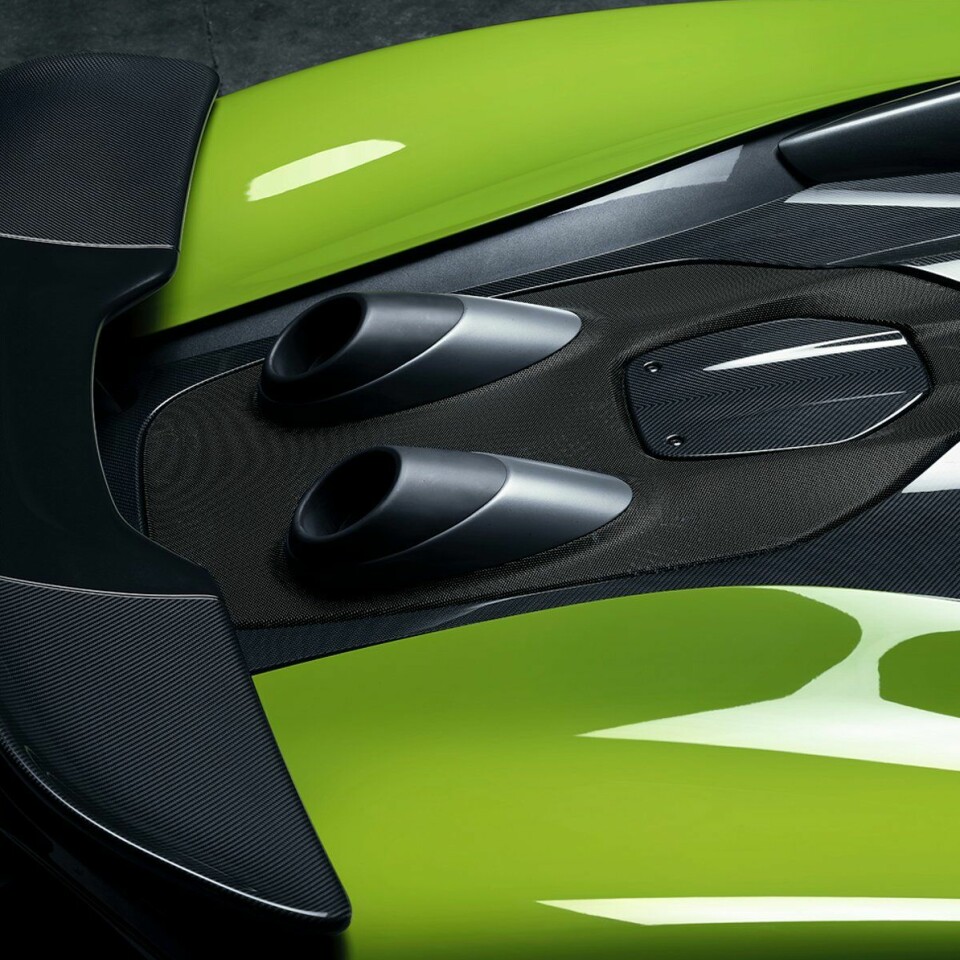
It is not only about styling and placement, but also materials. “In the past, exhausts were often accentuated with premium materials such as polished stainless steel, carbon fibre, or titanium, particularly on high-performance and luxury sports cars,” says Kurbos. “These enhancements not only contributed to the vehicle’s aesthetics but also reinforced the perception of power, precision engineering, and exclusivity.”
Mocellin agrees that “material selection and integration into the overall design are equally important” and flags Ferrari as a brand that has been “pushing the boundaries with sophisticated, uniquely shaped exhausts that enhance both aesthetics and functionality.”
Milltek’s Hall notes that the choice of material can tell the difference between a proper track-ready car and one that is simply ‘performance signalling’ for aesthetic purposes. “Materiality is often a giveaway, the iconic look of titanium or stainless polished to a mirror finish,” he says.
The future
Perhaps the reign of tailpipe design will be bolstered in the world of restomods, low-volume special editions and most likely in the world of aftermarket. “Many limited-series and collector vehicles continue to embrace bold, emotional, and nostalgic designs, ensuring that the tailpipe remains a key visual and experiential element,” suggests Mocellin.
Milltek’s Hall is also confident in that regard. “The demand for performance sports cars has not faded and with EV sales underperforming expectations we are confident this won’t change any time soon,” he says. The company has been tailoring options for performance plug-in hybrids, and there remains a focus on “continued improvement and development of iconic tuning cars such as the Audi RS4 B7 or earlier BMW M3s. These are cars that Milltek is confident true enthusiasts will be driving, modifying, and racing for decades to come.”

While Kurbos is certainly an enthusiast, he concedes that the long-term future for tailpipe design is less bright. Addressing the burning question head on – is there a future for the tailpipe as a core design component – Kurbos thinks not. “In the ongoing discussions surrounding sustainability, individuals who are passionate about environmental issues strongly desire to communicate their “green motivation” and commitment to an eco-friendlier future. Looking ahead to the long term, I firmly believe that the traditional ICE and its classic tailpipe will eventually become obsolete.”