Q&A takeaways
What are the opportunities in OLED lighting?

Car Design News audience members put live questions to a lighting supplier

The boom in lighting design has been largely attributed to emerging technologies. One very established one — OLED — is now well and truly embedded in automotive design, but what makes it so special?
In a recent webinar hosted by Car Design News and OLEDworks, we heard from global marketing manager Katie Miller and CTO and co-founder Michael Boronson, who addressed live questions from the audience.
Below is a lightly edited transcript as CDN's deputy editor Freddie Holmes relayed enquiries from interested professionals who joined the session, and posed a few of his own.
Car Design News: Katie, you opened the session by saying lighting has developed enormously as a design tool. What trends have caused that?
Katie Miller: I've been seeing so much intentional work with branding, and the opportunities are expanding so rapidly. From my perspective and from the conversations we're having at trade shows, people are excited about the possibilities of bringing new design elements into light and really developing their brand and their expression on their vehicles. Another thing I've noticed is that lighting is something people connect with early on. It almost creates the personality of the vehicle. It can make you feel like the driver itself is friendly, if the lighting appears friendly, or if the light's really bold it can enhances that personality in a different way. There's a lot of opportunity to keep working with different technologies, and OLED technology in particular is a really exciting tool.
Michael Boronson: There's two other really important things. As car design has become more aerodynamic, cars are looking increasingly similar. So to differentiate your brand from somebody else's brand, you can't do it with the shape of the exterior of the car, but you can do it with lighting. We're not using chrome or car shapes to differentiate — we're not putting fins on things --but we are putting on really unique lighting choices from car to car.
The other thing I think that's really important is, as we move to more and more automated driving, communication from the car to the surroundings becomes much more important. People need to know the intent of the car without necessarily making eye contact with the driver. And that is something that can be done with good external lighting, especially segmented lighting like OLED can provide. That can really be both a light source and a communication tool.
CDN: There's a question here about the integration of OLED into the lamp. Does the OLED have a tulip or a lens protecting the device?
MB: At this point, in all the actual applications that are on the road today and are being investigated, the OLED light source is still within the lamp itself, the sealed lamp that is always used in the rear combination lamp applications. For example, the OLED itself can be mounted in multiple ways. There have been applications where it was literally mounted on the backside of the lens. That's not as common as mounting it in the interior somewhere on a plastic mount of some sort. Because OLEDs are low heat, they don't require large heat sinks like LEDs might. So they can be on just a molded plastic support with double sided tape to hold it in place. And then it's positioned within that lamp as the designer wants, using depth or overlap or however they want to do it, or different angles. And then there is the sealed lens on the front of the lamp that's always there in cars today.
You're much better off designing specifically for the OLED in advance. But it can be done to back-fit
CDN: A follow up question here: what are the main challenges when integrating OLED into an existing vehicle E/E architecture?
MB: From my perspective, if a lamp has been designed initially for an LED, it's typically got quite a bit of depth because the LEDs need the depth for putting the circuit boards in typically parallel to the ground. They need lots of optics, they need diffusers and things like that. The OLED doesn't need any diffusers, it doesn't need heat sinks, it doesn't need any optics. So it actually can take up less space within an existing lamp.
If you're really just trying to transition from LED to OLED without designing the lamp specifically for OLED, you can do it. You just have to think carefully about how and where you're going to place the OLEDs. Because again, now you want to see the light source, you're not trying to hide it — you're not trying to bounce the light around — so that it comes out uniformly. That changes the design rules really. And you're much better off designing specifically for the OLED in advance. But it can be done to back-fit.
CDN: What are the possibilities of colour with OLED lighting? Can the same segment emit white, red and amber?
MB: First of all, every cell phone right now is a full colour OLED display. It's got red, green, and blue sub-pixels which allow the cell phone to create any colour combination you want by turning on the different colours to the right level. The pixels obviously are tiny, so your eye can't see them. With OLED lighting for automotive right now, segments are bigger than that. It's not a true display, we don't have say 4 million segments within the panel, because we're trying to do a lighting application with higher brightness compared to what a cell phone can do.
Because the segments can be seen, you can't really have separate colours side by side unless you're purposely going to light up some for one application and others for a different application. We certainly have developed panels of different colours: we have red panels, amber panels, white panels... cyan panels for the autonomous driving mode. So we can make any colour that's needed currently. We can't make different colours come out of the same segment, partly because of our manufacturing process; it's not inherently the limitation of OLED technology. It's just not something anybody's asked for from a practical perspective yet.

CDN: A question for you Katie. How will OLED redefine branding?
KM: In general, 25% of our driving is done at night. So having lit emblems or logos that are integrated into the light itself is an interesting way to reinforce the brand. There's so much work and effort that goes into each line, each curve, every stitch of the fabric that enhances the brand. And those same elements could be brought into the segmentation of the light itself, creating a really unique opportunity to add those detail into the OLED lighting.
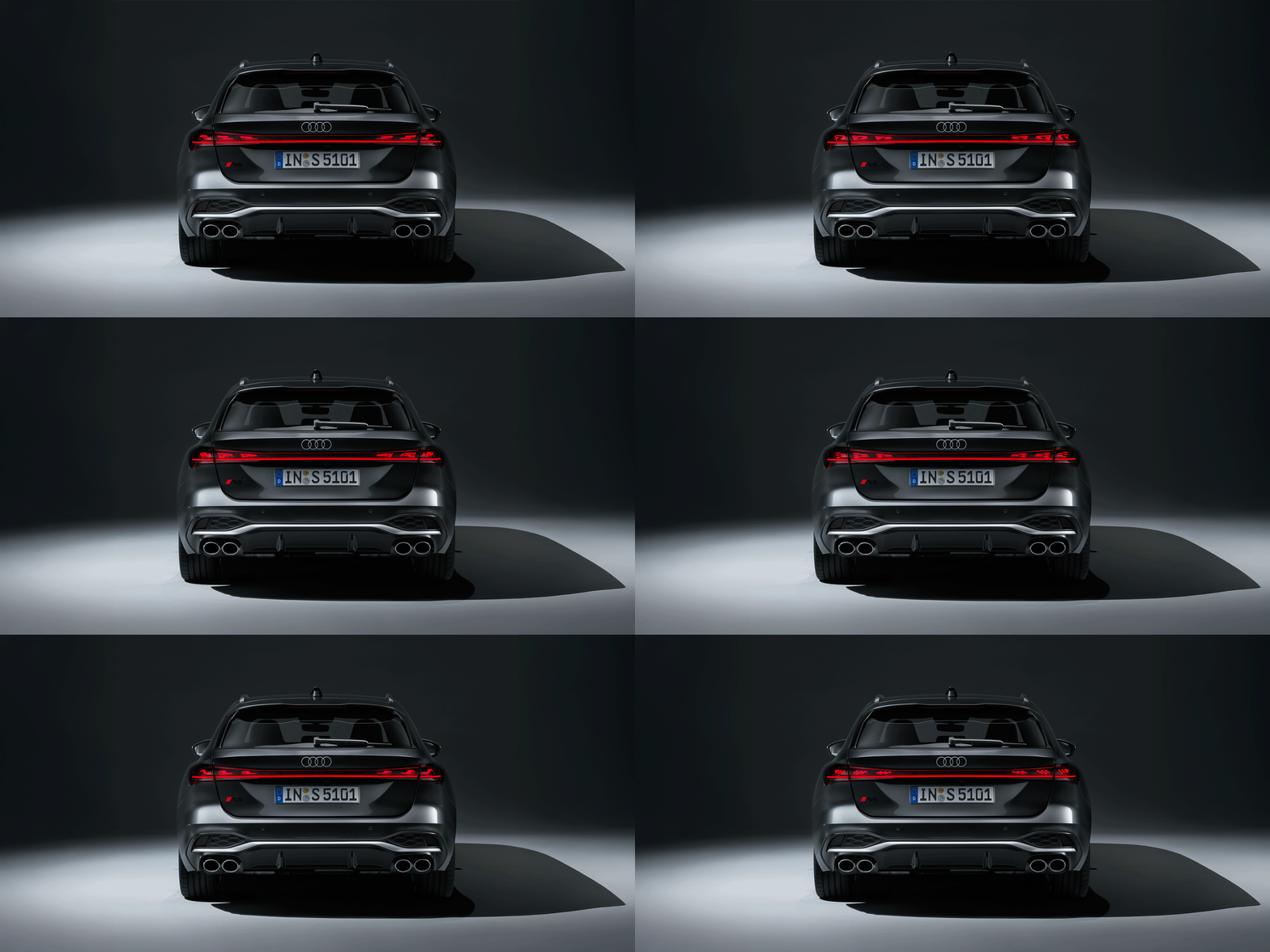
There's so many different ways to play with how you want to enhance your brand through OLED lighting or provide the opportunity to customers. We've seen Audi allowing their customers to choose how they want their lights to appear with eight different signature options, for example, so there's a really interesting way to bring in brand and identity and then also provide some opportunity to the customer as well.
CDN: And that's different to existing technologies, correct? OLED allows you to do something that hasn't been possible before.
KM: Yes, exactly, and even just with how crisp and clean the segments are. If we think about the diamond patterns that certain brands put so much effort into in their seats, that same diamond pattern can be pulled into the light as well as the opportunity to have dynamic interactions with their customers and the environment. So it's a really interesting technology and opportunity for brands to explore.
CDN: What about lighting as a tool for personalisation?
KM: If you think about how each segment is dynamically activated and individually addressed, you can create different appearances within a panel. Let's say you had a panel that was made up of different triangles. That whole panel doesn't need to be lit in a drive mode, so you can create different drive modes within one panel that could play with different shapes, geometries, 3D effects, and give the customer ways to personalise that. And then at the facelift period, instead of replacing all of the panels, you can just do a simple software update that creates an entirely different look on your vehicle.
CDN: What are the formability potentials of OLED? For example, is there the opportunity to do double curvature?
MB: We start with a flat piece of glass with our bendable panel. It's also still glass, but it's 0.1mm thick. They're bendable. So in other words, you could have an S shape that's bending in one direction and then the other. As long as it's not a twist, you can't do that with glass, but you can do all sorts of very interesting curves.
CDN: How do you see lighting as part of the whole in-car experience?
KM: I think it wouldn't be used in all applications in the interior. If you want directional light to go to a passenger so they can read a book, for example, that would not be a use case for OLED. But OLED is very elegant looking and creates very unique experiences and calming, even light. So when you open the door, you can have a panel in the corner across from the driver where it does a little welcome twinkle and a nice homogenous glare-free driving experience that can be lit. Especially as we're becoming more autonomous, there's less need for it to be dark while you're driving, so that glare free lighting will create really nice ambient experiences for the driver and the passengers. Not only that but very crisp and clean brand elements can be added in strategic locations around the vehicle that create crisply defined, beautiful enhancements as opposed to something that glares or wouldn't be as visible.
Your TV runs at around 500 Nits of brightness. Our tail light function has to be 2,000 Nits. And to use it for daytime communication, our OLEDs have to be 15,000 Nits
MB: I think the lack of glare is one of the key advantages. If you're talking about the lighting of the space itself, OLED panels generate a very uniform and calming light experience. And as we've been talking about over and over again, the sharpness of contrast of the segments allows any kind of branding or design recognition where you want a sharp edge — you just can't get with that LED because the LED has to be diffused, and then you get light leakage at the edges. It's partly why everybody loves OLED TVs and cell phones.
CDN: What's next for OLED technology? One listener has asked if there could be a "liquid light effect." I don't know exactly what that means, but it sounds interesting.
MB: I'm not sure what that means either, but we started with what we call OLED 1.0, which had a few segments that were fairly large. We've moved to 2.0, which is more like 25 square-millimetre segments and maybe 60 of them or 100 of them in a panel. OLED 4.0 is going to enable even smaller segments, maybe a thousand segments on a single panel. That's where you're getting into something that looks much more like a display, but still has all of the benefits of OLED in terms of sharpness as well as brightness. Your TV runs at around 500 Nits of brightness. Our tail light function has to be 2,000 Nits. And to use it for daytime communication, our OLEDs have to be 15,000 Nits. So you're talking about things that are orders of magnitude brighter than a display, but now getting more like a display. That's really where OLED are going to shine — pardon the pun.
KM: The development is so exciting: different colours, different segmentation possibilities, and further development into invisible segments and beyond is really exciting. Future possibilities of what will be next is yet to be seen, but the development roadmap is really exciting.