Test drives in Hamburg
Volvo EX60 HMI review: the software-defined Volvo finds new clarity

Car Design News gets hands on with the HMI of Volvo’s new mid-size SUV

Published
The Volvo EX60 celebrated its German premiere in Hamburg at the end of July, and we spent several hours testing the electric mid-size SUV around the Hanseatic city. The first impression is clear: the EX60 does not feel like an experimental technology demonstrator, but like a mature premium vehicle in which software, controls and driving dynamics have been developed as a more cohesive whole than before.
The EX60 is the first model based on the new SPA3 architecture, developed exclusively for battery-electric vehicles. Lutz Stiegler, Volvo’s head of architecture strategy, told CDN it was created “without taking conventional powertrains into account” and that it can be used to build “really only and absolutely only electric cars.”
That creates new freedoms for the front structure, battery, chassis and interior, but the EX60 is still immediately recognisable as a Volvo. The calm design, premium materials and clear architecture continue the direction established by the EX90 and ES90. The biggest visual and tactile difference is the significantly smaller steering wheel. It feels excellent in the hands, makes the EX60 seem lighter and is especially enjoyable on winding roads.

The digital experience is built around HuginCore, Volvo’s centralised computing architecture. An NVIDIA Orin X computer coordinates key vehicle systems, while a separate User Experience Computer handles the displays, infotainment and audio system. With 254 TOPS of computing power, functions can be linked more closely and developed further through over-the-air updates.
HuginCore builds on the technical foundation of the EX90 and ES90, but Volvo has fundamentally changed the processes behind it. “The tech stack is still similar, but the processes behind it are completely different, with the aim of significantly improving software quality,” says Stiegler. Lessons from the EX90, ES90 and Polestar 3 feed directly into the EX60.
Volvo is also developing more software in-house. This includes control software for the steering, electric motors, inverters, dampers and driver assistance systems. The central communication layer within the vehicle architecture also comes from Volvo. Stiegler estimates the in-house share at around three quarters.
Behind the steering wheel sits an 11.4-inch driver display positioned far forward and close to the windscreen. Technically, it is not a head-up display, but in use it comes remarkably close.
The driver’s eyes only need to move slightly away from the road. During our test drive, the display remains highly legible in changing light conditions and even with polarised sunglasses, information is easy to read. A special coating reduces reflections, while Dual Cell technology delivers high contrast.
Map, surround and focus views are also available; the surround mode is particularly useful because it shows which vehicles the sensors detect around the car. This makes the work of the assistance systems easier to understand and helps build trust.

On a poorly marked country road, Pilot Assist keeps the EX60 reliably centred for long stretches, sometimes even where visible lane markings are missing. Cameras, radar and high-resolution Google map data work together.
In difficult conditions, however, the lane guidance does not remain active consistently — and we shouldn't expect it to. On narrow, winding sections, the system switches several times between available and temporarily unavailable, highlighting that this is still very much 'assistance' and not 'automation'. The EX60 communicates these states very clearly: messages appear directly in the forward-mounted driver display, while green symbols show exactly when steering support is active again.
On straight roads confidence in the system builds quickly, but Pilot Assist is not designed – yet – to handle narrow or winding roads, and hands must remain on the steering wheel.

The centrepiece of the interior is the 15-inch OLED touchscreen. Unlike earlier Volvo models it is arranged horizontally and has a subtle curve. This makes it easy to read from both front seats while retaining a clear orientation towards the driver.
In the standard layout, Google Maps occupies most of the screen while the media player remains visible. A fixed bar at the bottom keeps important functions such as climate control within reach. Context-sensitive buttons appear only when needed, for example for the 360-degree camera or tailgate.
The return of conventional buttons is especially welcome
During the drive, the system responds quickly and smoothly. Maps load fast, menus are logically structured and configurable shortcuts bring functions such as One Pedal Drive or assistance systems closer to the top level.
The concept is not without criticism. Additional physical controls for the climate, steering wheel and exterior mirrors would be welcome. Steering wheel and mirror adjustments are first selected through the menu and then made with the steering-wheel buttons. Once learned, the process is quick, but it is not intuitive at first contact.

The new steering wheel is significantly smaller than before and noticeably changes the character of the driver’s environment. It delivers a direct feel and suits the EX60’s surprisingly agile handling.
The precise steering is also linked to the dedicated electric platform. Because there is no need to accommodate a combustion engine, the steering rack can be positioned ahead of the front axle. According to Stiegler, this improves force transmission and gives the engineers greater freedom when tuning the front axle.
The return of conventional buttons is especially welcome. Volume, voice control, display view, cruise control, following distance and assistance systems can all be operated without looking away from the road. The programmable star button is also useful as a shortcut, for example to disable the speed limit warning.

Google Gemini understands natural language far better than traditional voice assistants. In our test, the system responds quickly and reliably recognises open requests. It controls functions including navigation, Spotify, climate control and seat heating.
Through its connection to navigation and location data, Gemini can also answer questions about the surrounding area. A live function enables an ongoing conversation.
The system shows weaknesses when it comes to vehicle-specific knowledge. Asked how to adjust the steering wheel, Gemini returns a generic internet answer about a mechanical lever, even though the EX60 uses electric adjustment through the menu and steering-wheel buttons. In future, the assistant should function more effectively as a digital manual and lead users directly to the correct setting.

Google Maps is deeply integrated into the vehicle, takes range and charging stops into account and synchronises destinations with other devices. Apps such as Spotify can be installed through the Google Play Store. Wireless Apple CarPlay and Android Auto are also available.
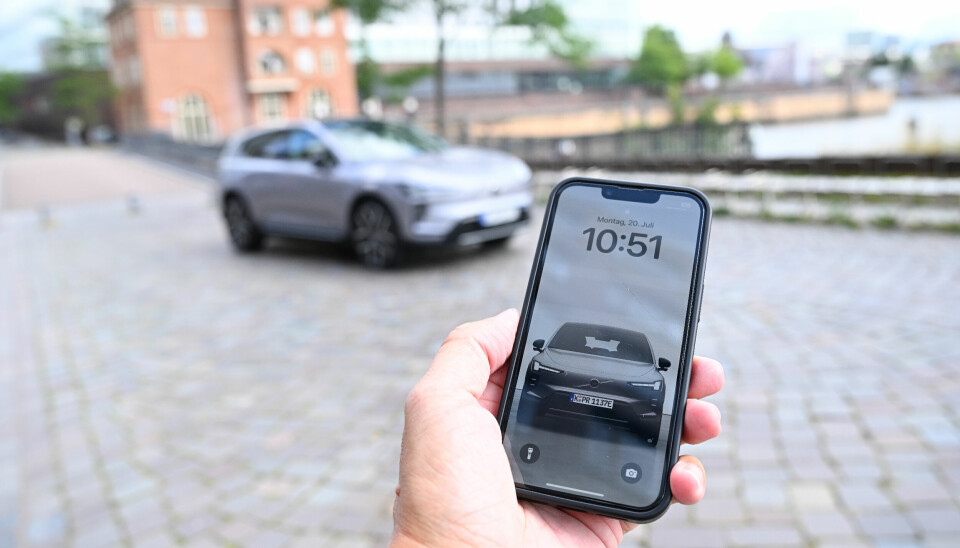
The smartphone also becomes part of the control concept. Using ultra-wideband technology, it can serve as a digital key and load personal settings for the seat, steering wheel, mirrors and infotainment.
The excellent 28-speaker Bowers & Wilkins system remains a highlight and different acoustic environments, including the Gothenburg Concert Hall and 3D surround, noticeably change the presentation. Buyers who can afford it and care about music receive genuine added value. In addition, noise-cancellation microphones are used to amplify conversations between the front and rear seats through the headrest speakers.

The EX60 combines Volvo’s familiar minimalism with a significantly faster and better-structured digital interface. The driver display, small steering wheel, tactile buttons and central OLED screen are particularly convincing.
Additional climate buttons would be welcome, steering wheel and mirror adjustment are initially more hidden than necessary, and Gemini needs a better understanding of the vehicle context. Overall, however, the infotainment is enjoyable to use, the interior feels premium and the interaction between software and vehicle already works very well.