Fresh from Barcelona
First look: Cupra unveils new Raval

The sporty Spanish carmaker has taken the wraps off its new urban electric vehicle, specifically designed to appeal to a young demographic
Rising into the grey Barcelona sky, Las Tres Xemeneies (or 'the three chimneys' in Catalan) sits just north of the city on the edge of the Balearic sea. This monumental structure was once a power station that provided electricity to towns and cities across Europe before the doors closed in 1989. It now serves as an enormous event space, its cavernous halls a maze of concrete pillars, and the venue Cupra has fittingly chosen to take the wraps off its new urban electric car, the Raval.
On the outside
Positioned as a compact EV, the Raval sits somewhere between the Born and the Tavascan in Cupra’s line up. It measures 4,046mm in length, 1,784mm 1.8m in width, and 1,518mm in height – perhaps a little on the large size for a true urban runaround, but small enough to slot into a busy city carpark.
At first glance, the Raval’s exterior seems typically Cupra, with muscular body work and sporty sharp lines. The front end is defined by the brand’s synonymous “shark nose” shape, emphasised by two sliced grooves in the bonnet and the large LED headlamps, with the illuminated logo sitting front and centre. Two air intakes connect pleasingly to an indented curve that runs the width of the front, sitting just underneath the lip of the bonnet, while another two intakes push out from the low centre grille section.
Advertisement

Everything is neat and tidy along the sides. The wheel arches don’t protrude much, which means that the bodywork is fairly clean aside from a subtle accent line and a slightly chunker wheelbase line, both of which rise gradually from front to back. Handles are flush in the door panels, accented by lights when used.
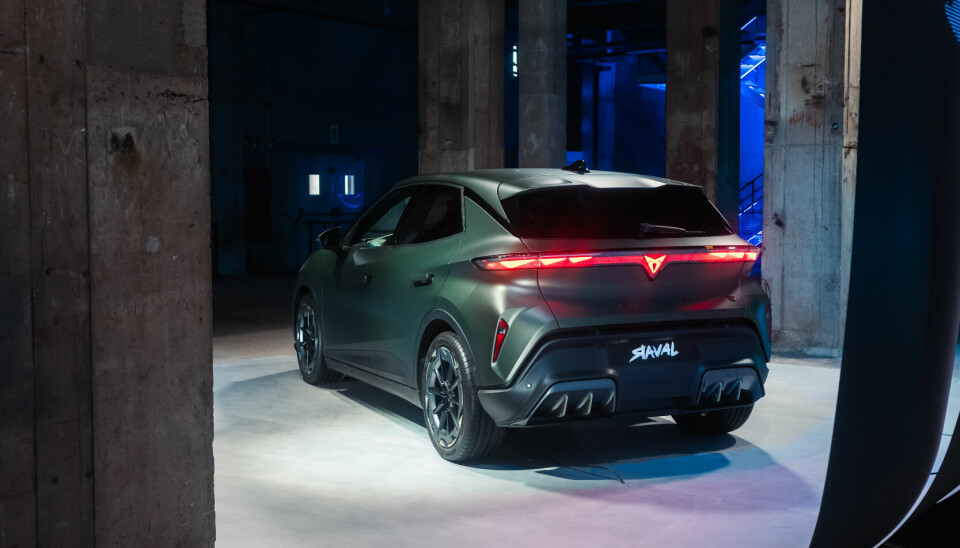
Lighting also plays a key role at the back of the car. 3D effects bring the light bar to life, while a rimless illuminated logo adds more character. The reverse and fog lights are both placed on the lower reflector. It is very neat and tidy, while also feeling modern and distinctively Cupra.
Customers can choose from seven paint finishes, and the Raval is the first in Cupra’s lineup to feature ‘plasma’ iridescent. There is also an option to choose a different paint for the roof, if two-tone customisation appeals.
The inside
Climbing into a deep driver’s bucket seat, it quickly becomes clear that Cupra has loaded the interior of the Raval with technology and details. Despite this, the experience does not feel overwhelming.

Lighting again plays an integral role. A wraparound dash includes an illuminated upper that links to animated door projections, providing an immersive ambient lighting experience with seven different modes to choose from. This does not appear excessive while the car is stationary and under some bright photography lights, but will likely feel a little different on a dark country road.
If I had to choose one characteristic of Cupra that defines the brand, it's design
The dash also features what the company is dubbing ‘Smart Light Next Generation’. This is another layer of lighting that is connected to the driver assistance systems, like the new semi-autonomous ‘Travel Assist' feature, and has been designed to provide visual feedback through animation.
Advertisement
Further information is delivered by two screens. A 10.25-inch digital driver cluster is tucked away behind a redesigned flat bottom steering wheel, while a 12.9-inch infotainment system sits above the floating centre console and is the first in the company’s lineup to use a new Android-powered operating system. Although everything can be controlled from this central screen, a small selection of buttons and switches are included on the steering wheel to allow for easy access to certain functions.

Sustainability is also a key touchpoint for the Raval’s interior. Recycled materials are used to upholster the seats, with the top-of-the-range trim offering a 3D-knitted cover that consists of 100% recycled material. There are also 3D-printed inserts on the dashboard, providing an extra touch of character.
The immersive lighting experience is complimented by a new, custom-made, 12-speaker Sennheiser sound system. It has been specially tuned for the Raval, with the goal of creating a “differential multi-sensory experience”. While it certainly makes for a more premium experience, the standard seven-speaker set up still provides plenty of audio punch.
Under the hood
A selection of different battery and motor configurations offer choice to the customer, depending on range and power requirements.
The basic trim comes equipped with an 85kW electric motor coupled to a 37kWh lithium iron phosphate (LFP) battery that delivers around 300km of range and has a 10-80% charge time of 27 minutes when using a 90kw DC charger. This can be upgraded to a 155kW electric motor with a 52kWh nickel manganese cobalt (NMC) battery, boasting 450km of range and a 10-80% charge time of 23 minutes when using a 130kW DC charger.
For increased power, the VZ trim features a 166kW motor that delivers 290Nm of torque, a top speed of 175kph and a 0-100kph time of under seven seconds.

The engineering team has developed a new ‘one box’ electronic braking system that features for the first time in the Raval. By merging the brake servo and ESC modules, the system aims to improve the pedal feel and braking for an enhanced driving experience.
Advertisement
Further customisation comes in the form of the chassis control system with adaptive shock absorbers. Drivers are given 15 levels of adjustment options, ensuring the suspension can be optimised for road surface and performance requirements.
Designing for love
“If you were to ask me to choose one characteristic of Cupra to define the brand, I would answer with design,” Markus Haupt, chief executive of Cupra, explains to CDN. Sitting down next to the Raval, he emphasises the importance of using design as a brand differentiator, and how this will be crucial for the launch of the Raval.
“We are aiming to capture the imagination of a new generation with this car, and design is at the heart of that,” he adds. “We need to be consistent with what we do as a brand, so our cars will naturally have common design elements, but we also aimed to make sure that the Raval was unique and instantly recognisable when it passes by, and that people fall in love as soon as they see it.”