Niels van Roij on coachbuilding and shooting brakes
RCA alumnus and certified coachbuilder Niels van Roij has found an exciting niche in handcrafted one-off projects, many of which appear in the form of a shooting brake or 'bread van' format. The designer sat down with CDN to explain why it is still 'design' in a conventional sense, and details one project involving a Ferrari 550 Maranello



It is not often that a designer arrives in a suit made from the same materials as a car they have designed, but that is exactly what Niels van Roij did when we met him in Munich this week.
Speaking at the fourth edition of Car // Design Event, his suit and waistcoat combo was a reflection of the striking Ferrari 'Breadvan Hommage', effectively a wagonised 550 Maranello.
From pencil sketches, clay models and hand-beaten bodywork, it is an exercise in the 'romance' of car design, van Roij tells Car Design News. We also receive an education on what is, and what is not, classed as a shooting brake.
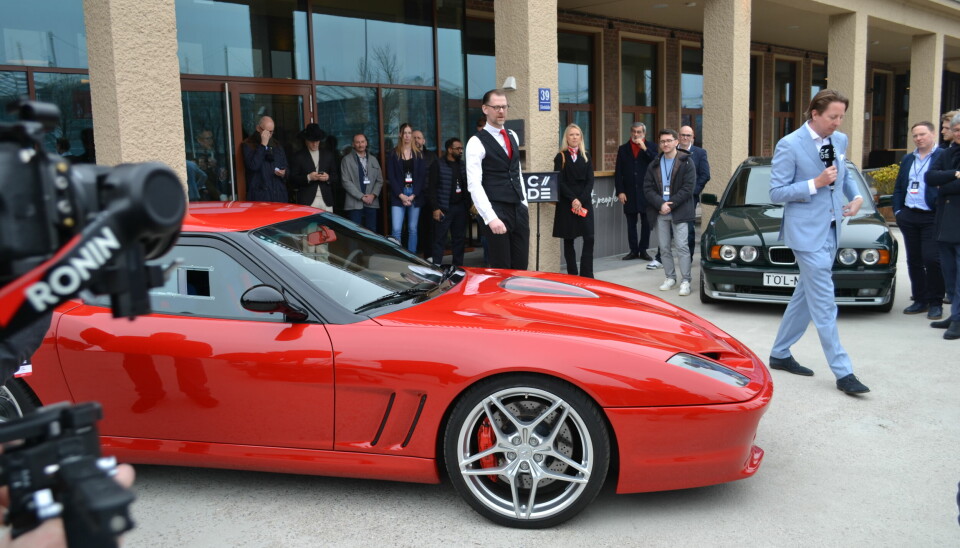
Car Design News: Niels van Roij, the coach builder extraordinaire. Thank you for joining us. Thanks so much. Yeah, we were just talking about your, your amazing, some of the amazing cars you're working on and you've brought one with you today. Can you tell us a little bit about what we've got here in Munich?
Niels van Roij: Yeah, it's our Bread Van homage. And this is a 550 Marenello-based one-off that we designed a couple years back, fully coachbuilt by hand, as in without any computers. That's what really sets this car apart. This client made it a point where he said that he really enjoys the romance of a car that is built by craftspeople. So we took the body off on the actual chassis, built the full-size clay model and from there started doing the aluminium bodywork. And like I said, without any computer involvement. So everything was measured in the old way.
CDN: Just for the pure romance of it, like the good old days.
NvR: Yeah.
CDN: How are you finding it as a coachbuilder? Do you see yourself as a conventional designer, or is coachbuilding something separate to that? Because you studied at RCA, so you are of that pedigree.
NvR: Yeah, I would say it's car design. Whether it's Hyundai or Rolls-Royce, it's all car design. And whether they're made by the hundreds, the thousands or only one — we only do one offs — it's the same thing eventually. So I would say, yeah, I'm a car designer.


CDN: And you've got an affinity for the shooting brake. Where did that come from? When did the 'problem' [laughs] start?
NvR: The problem started with Model SB, as we baptised the car, a Tesla-based shooting brake conversion built on a Model S. And I personally indeed do like shooting brakes. But that doesn't really matter because I don't decide what we're designing or building. It's all client commissions. Our clients are drivers and they like to take their car out and about and the shooting brake is sort of the best of both worlds. You usually have a nice engine up front and a bit of extra luggage space compared to a coupe or perhaps a saloon model. So that's something that really draws clients in, and that's what we do a lot. Hence the shooting brake line up in our portfolio.
CDN: Do you draw a line between what is a proper two-door shooting brake and a four-door?
NvR: Well, that's an interesting question because Mr. Floris de Raadt, the owner of Model SB, has restored shooting brakes all his life, from the Cadillac that Elvis once drove, to the Jaguar XJS-based Lynx Eventer, which are beautiful conversions. With the Model S, we said okay, we'll move the B-pillar back and take out the rear doors, but he wanted to keep the rear doors. We suggested this would technically be an estate, but he corrected us and explained that's a common misconception: a shooting brake is a car that has been converted. That's the real definition according to him, and he has done lots of research. A shooting brake has to be coach built and the amount of doors don't really matter.
CDN: I never knew that.

NvJ: If you look at the 20s and the 30s when a lot of Rolls Royces and Bentleys were converted, these cars were used for hunting and often had five doors or even six if you include the barn door at the back. So the amount of doors is not really relevant; it doesn't make or break the 'shooting brake-ness' of a car. It's the fact that it's coach built and not a mass production car. All that is still probably open to debate but I do like that idea that if you look back in history many cars were marketed as shooting brakes by their coachbuilders and they were five- or six-door cars as well as the three-door sportier versions.
CDN: So maybe over time it's just become this sort of truth by proxy. If we repeat it enough, it becomes fact.
NvR: Exactly. The Lynx Eventer I just mentioned is of course a fantastic car — almost a halo car for shooting brakes — and then there are the DB5 shooting brakes, you name it. Those are iconic pieces of car design and are slightly younger than the ones from the 20s and the 30s that have been now forgotten by most. So probably you're right.
CDN: Very interesting. Well, Nils, thank you so much for joining us.
NvR: Thank you for having me.