Mahindra's boundary-pushing product
"Design something people genuinely want" – Pratap Bose, Mahindra CDO

Mahindra's chief design officer Pratap Bose shares his thoughts on the all-new BE 6 and small cars
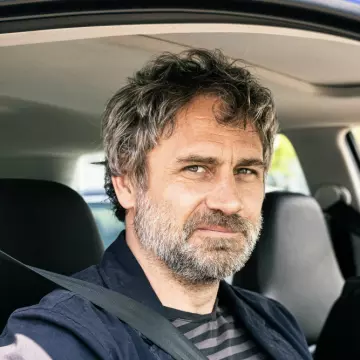
Mahindra's BE 6 has emerged as one of the most striking new EVs on the market, helping to redefine perceptions of the Mahindra brand. Developed on the company's dedicated Inglo platform, the SUV combines dramatic styling with a design philosophy that chief design and creative officer Pratap Bose calls "visual performance" — the ability to create an emotional, visceral response that can't be measured on a spreadsheet.
Car Design News caught up with Bose at the 2026 Move conference in London to discuss the origins of the BE 6, the challenges of balancing aerodynamics with desirability, and why the future may belong to multi-energy vehicle architectures.
Car Design News: The BE 6 is a striking vehicle. Before we get into the details, talk us through the thinking behind its design.
Pratap Bose: The design team became involved right at the architecture stage when we were developing the Inglo platform. Very rarely do designers get the opportunity to intervene that early in the process. The engineers literally asked us what we wanted in order to create what I call "visual performance".

Every type of performance can be measured in an Excel sheet, but visual performance can't. It can only be felt. A design has to perform at a visual and visceral level, and to achieve that we needed certain architectural hard points from the beginning.
When aerodynamics overtakes everything else. You end up with a single "correct" answer that's devoid of brand identity or character
CDN: What were those key requirements?
PB: Wheel size and ground clearance were critical. Every Mahindra needs at least 210mm of ground clearance because we're an SUV company. That naturally conflicts with aerodynamic requirements: the lower the vehicle, the better the efficiency. But we wanted to stay true to what a Mahindra is.
Even with an EV, we believe customers choose emotionally before they choose rationally. Of course, the rational side is important too. With the 80kWh battery, the BE 6 can deliver around 550 kilometres of real-world range in Indian conditions, meaning many customers only need to charge once a week.
CDN: Early in the EV transition there was a belief that they should look fundamentally different. How did you approach that?
PB: One of the instructions from our CEO was simple: make a desirable car. Let people fall in love with it first and then realise it's an EV. Don't design an EV around what it is mechanically — design something people genuinely want.
We certainly embraced the aerodynamic opportunities. The wheel wells create a huge amount of turbulence, so we paid close attention to airflow management there. We also used floating roof spoilers to keep airflow attached. But we didn't want the car to become a bar of soap.
That's the danger when aerodynamics overtakes everything else. You end up with a single "correct" answer that's devoid of brand identity or character. We always balanced aerodynamic performance against visual impact.
CDN: The BE 6 also introduced a completely new design language for Mahindra.
PB: Yes, because this wasn't a language that existed anywhere else in our portfolio. That's why we created the BE brand. Around 70-80% of customers coming into the showroom to buy these vehicles aren't existing Mahindra customers.
What's particularly interesting is the effect this desirability has had across the wider business. In 2021, Mahindra sold around 160,000 to 170,000 SUVs annually in India. Last year we reached around 650,000
units. I'm not saying EVs alone drove that growth, but the desirability they've created has benefited the entire brand.
CDN: One of the most distinctive aspects of the BE 6 is the way the surfacing and graphics break up the mass. It feels athletic rather than heavy.

PB: When Cosimo [Amadei] first sketched the vehicle, he envisioned a sports-car upper body sitting on an SUV architecture. That's exactly what we've delivered.
The way the volumes are visually separated creates a sleek upper body that sits on a strong, muscular base. The vehicle feels rugged and powerful despite being relatively compact. In fact, it's roughly the length of a Volkswagen Golf.
We wanted customers to recognise a BE 6 instantly, even from a small visual cue
CDN: How important is road presence in the Indian market?
PB: It's incredibly important. That's exactly the phrase we use: road presence. Cars are often very close together in Indian traffic. You don't always get the opportunity to stand back and admire a vehicle from a distance. You're often viewing it from another car only a few feet away.
That means every part of the vehicle needs to be recognisable. Even if you only see a small section of the car, you should immediately know it's a Mahindra.
CDN: How did that influence the design process?
PB: I always break design down into three elements: proportion, surface and details. Once we had the proportions and surfacing established, we worked extremely hard on the graphic details.
Those details become especially important when people encounter the vehicle at close range. We wanted customers to recognise a BE 6 instantly, even from a small visual cue.
There are also subtle references throughout the vehicle. For example, our Formula E team is based in Banbury, and the halo-inspired elements inside the cabin are a nod to Formula E technology.

CDN: The BE 6 also seems to have pushed manufacturing capabilities.
PB: Absolutely. Take the two-tone roof, for example. We use an inkjet print-head process that eliminates the need for masking while still producing an incredibly crisp line. That improves efficiency and throughput in the paint shop.
The body side is another example. The roof channel running down into the wheel arch is formed from a single stamped steel panel. We've never produced a stamping that deep at Mahindra before, but we didn't want visible joins interrupting the design.
There are many technical innovations like that throughout the vehicle. This was a difficult car to manufacture because we'd never built anything quite like it before, but the engineering and manufacturing teams rose to the challenge.
CDN: How will the lessons learned from the BE 6 influence future products?
PB: Mahindra is a house of brands. We have Thar, Scorpio, Bolero, XUV and now BE. Each can have its own distinct design language and personality.
I believe there will be opportunities for new categories of smaller vehicles in Europe
The visual identities remain unique, but underneath there are common lessons around architecture, presence and engineering. The innovations developed for the BE 6 are already helping us improve future products across the portfolio.

CDN: What's next?
PB: We'll introduce the BE 7, which is a larger, more mainstream SUV but every bit as striking. Beyond that, our new IQ platform products begin arriving from 2027.
Many of those vehicles will sit in India's sub-four-metre segment, which accounts for around half the market. We currently have relatively few products there, so it's a major opportunity.
Designing a vehicle that's under four metres long, crashworthy and still has genuine road presence is a unique challenge. It's a category that's very specific to India, but I think there are lessons there that could prove relevant elsewhere.
CDN: Particularly as Europe rediscovers the value of smaller vehicles?
PB: Exactly. I think what Renault has done with the new 4 and 5 is phenomenal. They demonstrate how compelling a small vehicle can be when it's designed properly.
Space is becoming an increasingly important issue in cities around the world, and I believe there will be opportunities for new categories of smaller vehicles in Europe. If that happens, some of the experience we've gained in India could become very relevant internationally.