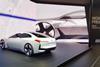
Should an alternative fuel vehicle look any different from a regular car? Honda seems to believe so with its FCX series of fuel cell technology cars that have evolved a look that's not only distinctive but clearly signals the advantages offered by this new technology in terms of packaging. But it hasn't been a simple journey.
For a start, it's easy to be confused over the FCX name as Honda has used this Fuel Cell Xperimental suffix on several different fuel cell cars since 1999. The original FCX that debuted at the Tokyo show in 1999 was a methanol-fueled sedan with a characteristic 'big forward cabin' profile that set the theme for subsequent fuel cell cars from Honda. It suffered though, from having odd proportions with an extremely short nose and over-long rear overhang combined with very gentle, organic styling that was already a bit old fashioned by that time.
This was followed by the odd Kiwami concept in 2003, with its squashed MPV profile and minimal tumblehome, yet it showed how a supercar-like profile could work on a four-door sedan and take advantage of the latest FC layout. Meanwhile, Honda showed a small prototype city car series, also called FCX, which have been developed over several generations and are now on limited trials with customers in Japan and the USA.
This latest FCX brings together several elements from those previous concepts and builds on them. Like the Mazda Senku, it's a classically automotive design that's fluid and dynamic, with restrained detailing and a great sense of elegance that was so lacking in the previous FCX and Kiwami concepts. The design is defined by that 'one-flow' profile, with a fast raked screen and long rear deck. It's a profile that goes right back to the Bertone Stratos or Pininfarina Modulo showcars of 1970, yet on this car it's been carefully massaged to suit an Accord-like package for four adults.
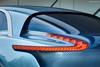
The Kiwami introduced the visor lightband front end treatment and the kicked-up quarter window in front of the doors but both ideas have been further refined here. The front end advances this visor lightband theme, also seen on the new Civic, and adds a new three-bar grille treatment that moves Honda's face on into new territory. The flowing rear deck hints at the 'surf roof' theme that Honda have employed on the Insight, Stream, Civic and CRX models over the years, while the rear features a full-width red lightband, relieved by slim chrome strips and a chrome H-Mark. The overall result shows how, over three generations, the design has matured into a very handsome and polished form that's uniquely Honda.
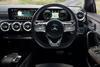
The interior uses contrasting materials such as futuristic transparent plastics and classic leather and wood to produce an advanced, yet warm, ambience. The main IP section is a convex blade of hardwood and leather that can rotate up by 45 degrees at high speeds to provide a greater feeling of security, while tilting down at low speeds to open the space for a more relaxed feel. The steering wheel, instrument binnacle and pedals move fore/aft as one unit to adjust to the optimum position using biometrics.
The front console has two floating layers: an upper one with an elegant scroll shape that dives directly under the IP while the lower console spreads sideways to run around the occupants' knees and connect to the door. The door linings are simple curved forms that link directly to the seats when the doors are closed to complete the loop formed by the lower console. Door armrests are made of hardwood capped with leather, cantilevered in a graceful scroll shape that is quintessentially Japanese. Other nice touches include head-up icons for main functions that recognise the drivers line-of-sight to operate the switches accordingly and slim indicator stalks that remind one of elegant pens or elongated USB memory sticks.