Feature
In focus: cross-disciplinary influences

Car Design News explores how other industries continue to shape the design direction of new cars

Car design may feel like its own little bubble at times, but the reality is it intersects so many other creative disciplines.
There are the professional crossovers – shared tools, workflows and often raw materials – which can be found across cars, watches, fashion, furniture, architecture, product design… You name it. Then there are the more thoughtful, deep-thinking angles – the shared mindsets and principles. We have all heard this many times before and it is why car designers sometimes find themselves leaving, or at least side stepping, into different industries. And vice versa – just ask Paul Smith.
Occasionally, designers get the chance to do both. Alessandro Dambrosio worked on a Leica camera during his tenure at Audi, for example, and at Italdesign Joaquin Garcia enjoyed a broad portfolio of products alongside cars. (Perhaps underlining the point of this article is his move to the Electrolux Group in March, where a ‘car guy’ will continue to design things other than cars).

Watches in particular seem to be creative catnip for car designers, as we learned in this feature. Many recognise the relevance between a mechanical timepiece and a vehicle; a blend of form and function produced under enormous constraints. A book by Oriol Vilanova (now working in design strategy at Xpeng) goes into great depth on this, and frankly any glance at the wrist during a networking event makes clear that designers appreciate horology.
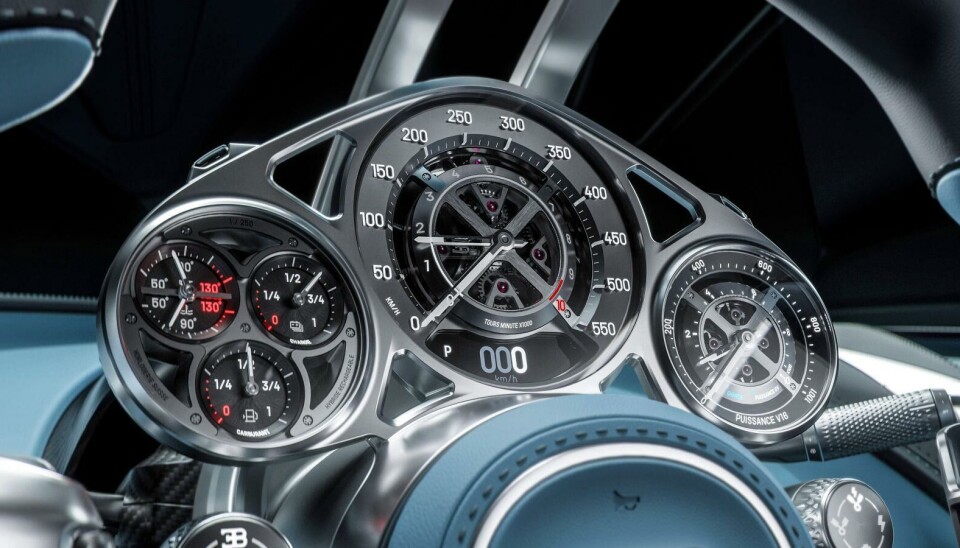
When we talk about cross-disciplinary influences, there are different levels. From the broader, less obvious – the treatment of key details and switchgear – to the more literal, such as naming a car after a technical automatic watch movement and designing the instrument cluster around it. The Bugatti Tourbillon certainly ticks both of those boxes. Aesthetics aside, design director Frank Heyl points to longevity as the guiding principle:
“If you get into a car made ten years ago and fiddle around with the navigation system and screen, it’s a rather miserable experience… Fast-forward another 90 years and will we have augmented reality implants? Or holographic displays? Who knows? So we chose the Tourbillon, like a mechanical watch, to be timeless.”
Great influence also from the world of rail and aviation as brands seek to imbue a ‘first class lounge’ vibe to their interiors, as well as the aerodynamic principles of cutting through the air at high speed. And like cars, they are often described as dynamic sculptures. By that analogy, all those transportation devices become sculptures at rest, more structural – like a building. Architecture is indeed one of the big automotive inspirations and a list of conversations that reinforce that would be longer than your arm.
Former Audi design boss Marc Lichte told us of his fascination with the work of Bjarke Ingles; Maximilian Missoni is a regular of the Venice Biennale; Stephane Janin wrote a book on the parallels between cars and buildings; and even our very own editor-in-chief James McLachlan has delivered presentations on the Barbican Centre in London. More recently we heard at CDD Detroit 2026 how Mazda designer Jacques Flynn works with light and shadow based on the principles of Japanese architect Tadao Ando.

Furniture design is a given – as is an affinity for the work and mantras of prolific industrial designers like Mies van der Rohe, Dieter Rams, Kenneth Grange and co., who showed the power of strong design principles across a broad range of products. As cars chase interiors that feel more like home – just look at Polestar’s latest ad: “Is the car something that gets you there, or a place to be?” – it is only reasonable that living spaces become even more relevant. Add to that the hunt for autonomous driving and the entire landscape of the car interior is shifting.
If a car does not need a human pilot in the front row, does it become a cinema, an office, a place of refuge from the outside world or perhaps even a gym or restaurant on wheels? We suspect those with motion sickness will have strong opinions. Either way, conversations between car design and those auxiliary industries are no doubt becoming less conceptual and more concrete. Simply put, outside influences may well transition from ‘broad ideas’ to ‘mirrored solutions’: the world consumer electronics already feels very much aligned with automotive UX.

With interest in CMF seemingly at an all-time high, there remains a strong case to be made for the influence of fashion where new materials and processes can be showcased at a rapid clip. Many designers admit a desire to replicate that pace and be more explorative with car interiors, but regulations make that immensely challenging. We are seeing progress though. Recent concepts have shown how 3D-‘knitted’ materials (commonly seen in sneakers) are due to find their way into the cabin, such as for seat structures. At the other end of the market, collaborations continue to prove how automotive luxury can be elevated further by masters of high fashion.

As for discreet trends, we suspect car design will be increasingly led by ‘adventure’ culture. The worlds of fashion and outdoor have collided to a point where hiking outfits are now a fixture of fashion week runways. ‘Gorpcore’ is all the rage, and the trail aesthetic unavoidable even in the heart of a city. It continues a well-trodden path of athleisure – cycling, golf, tennis, football (soccer) and running to name a few – shaping broader cultural trends.
This might seem tangential but it is a signpost for where car brands and model typologies could be headed. Citroen’s versatile ELO concept was conceived alongside French ‘outdoorsy’ company Decathlon, for example, and spoke directly to this phenomenon, complete with visuals of families heading out to bike, hike, surf and camp.

The Brussels motor show earlier this year offered a library of similar stories, from brands you’d expect like Jeep and Subaru to less obvious cases like Smart and BMW. In April, Mini launched a pair of show cars under the mantra of “adventure attitude and sound culture”, designed for “community culture and festival lifestyle.” They feature large speakers mounted externally on the C-pillar, a roof-mounted tent set and chunky cladding around the lower extremities to convey all-road ability. If we are keeping track, the influences to tick off are: product design, camping gear and off-roading.
There are different takeaways that can be drawn from all this. One is the obvious short-term clout of partnering with a brand in vogue to bring fresh relevance to an existing product and tap into hype. Think Alpine x Lacoste; Mercedes x Moncler. The other is that outside inspiration can move a brand into new territory and engage a slightly different customer base. Sticking with the earlier example, one could imagine a new Mini off-roader entering the mix down the line after testing the waters with those show cars, or perhaps signalling a heightened focus on premium features and audiophile-level sound systems. Collaborations beyond automotive allow brands to explore and try new things, but also signal a slight change in tack.

So dear reader, why has the team at CDN dedicated an entire month towards cross-disciplinary influences? For one, it is important to pause and take stock of the outside forces that are shaping cars of today and tomorrow. The industry is, as they say, in flux. New technologies are emerging and talk of homogeneity is growing louder. Understanding how to stand out from the crowd is crucial, and answers may lie in fields adjacent to the car world.
And most importantly from a creative side, it is an opportunity to dig into the artforms that inspire us all or proffer moments of delight, be it the watch on the wrist, the sneakers on the feet, the art on the wall or the embrace of an Eames lounger. What inspires you?